Same thing is happening in Russian Wikipedia. Majority of articles are written from the official pro-Kremlin point of view and any attempts to change that are blocked. Given that there are millions of Russian-speaking people live outside of Russia, something like this split needs to be done.
The uncomfortable truth is that many average Russians support "the official pro-Kremlin" outlook. Similarly, if the Chinese Wikipedia was not blocked by the government, it would probably look a lot like Baidu Baike, and all the articles about "sensitive" topics would be whitewashed and socially harmonised by the "great human flesh search engine crowd". The Chinese government is actually doing Wikipedians a favor by keeping the nationalist masses from accessing the site!
The article argues that it was the split of Serbo-Croatian Wikipedia into country-specific Wikipedias that fractured the community and enabled the takeover of the Croatian Wikipedia.
I remember having a very heated discussion on some pretty recent historical events with a few Russians. At some point I thought I'm in some sort of an alternative reality.. However, eventually,after almost smacking each other faces, we figured that the way we were taught at school was miles and miles apart and they didn't know any alternative opinions. It took quite some effort to at least acknowledge it.
I concur. It's usable if you want to know how T-72B2 differs from T-72B3 but is heavily editorialized for most non-technical topics, not even directly political.
I’m not sure if it’s the same kind of situation, but the Macedonian Wikipedia is absolutely rife with all kinds of nationalist pseudo-history and ethnic-based bias.
I think this is a problem for a lot of multilingual online platforms. On Facebook there are pages in Macedonian that constantly publish completely vile hateful material against Bulgarians, Greeks, and Albanians. These pages would absolutely be banned, except it seems that Facebook lacks the linguistic and cultural ability to understand what this content is and to do something about it.
...and when you report them, the canned answer is "it doesn't go against our community standards". I wonder, do they have different community standards for non-English, or censor English only punctually because they were pressured to intervene?
This kind of vulnerability seems to be a very difficult one to plug. Ultimately, Wikipedia should be seen as a source of information, but not to be trusted blindly. That's a good stance to take purely out of factual inaccuracy and data incompleteness - but also necessary from the perspective that Wikipedia has, is and will be used to influence because it holds an authoritative position.
As a Croatian-American who speaks Croatian, you never want to go to the Croatian version of Wikipedia. Anyways, a lot of this pressure being put on Wikipedia/Wikimedia is through the investigative journalism organization, Balkan Insight (see links below that I referenced).
The reason why people do this stuff is because not only do they want war—-they want to commit genocide again.
It [Wikipedia] does have power over what it allows to be published, although it does not have the staff to enforce violations. As a Croatian-American who speaks Croatian, it is best to avoid the Croatian language Wikipedia pages about wars, with some more recent than others. It is quite hateful, xenophobic, and nationalistic. The news source I provided is investigative journalism for Balkan countries funded via European Union.
> "Wikimedia Foundation Inc, the US-based non-profit charitable NGO, is the owner of the Croatian version of Wikipedia." [1]
> "However, the Wikimedia Foundation is not the founder of the Croatian version, nor does it accept that it is responsible for the accuracy of its articles. It insists that it does not have any power over Croatian-language Wikipedia entries." [1]
I second your recommendation of Balkan Insight as a reliable source. I've lived in Croatia for ~5 years training local LEA's in modern cyber and intel techniques (OSINT being a large part of it).
The older population is still deeply divided over the horrors of the war with many veterans living on government money (some of them have never seen a fight). I have a lot of trust in the younger people who are sick of it all, want change and believe in integration, free movement (within EU) and modern values. But if you go out for drinks in a less touristy bar that you'll find yourself amidst a celebration of war criminals and/or people who benefited from the spoils of war (and organized crime that goes hand in hand there). Fun facts: the owner of Rimac is building his car company on his fathers criminal empire, the hooligans supporting the local Zagreb club (some of them Neo Nazi's) are being celebrated for enforcing the law in places where the police has no power or helping with local community efforts (rebuilding the city after the earthquake), ...
There is a saying in Croatia "Where were you in '92" that is reserved for the older population. You never know who you are befriending and what crimes they got into during the war.
Among the most horrible people that stem from the place are the modern elite. Anyone who shows their money and who often no longer live there. The owner of "Konzum", a huge grocery chain where the owner built his empire on war money and extracts the revenues via off-shore companies while sitting comfortably in his flat in London while his employees scrape by with shit working condition and terrible pay.
There is also the puppet-mayor of Zagreb who peddles most of his contracts to the Bosnian mob and who is unable to speak up. It really pisses off the older Croatians.
The top lawyer of the country is in the mob, as are several judges. The Hack club "Mama" in Zagreb is constantly harassed by the local criminals who want them to vacate the premises so they can rent it out for higher prices, despite a long term contract being in place. Many of the trendy cafe's are run by the mobsters wifes, GF's and sisters. You can get a great deal there in the middle of the town for lease for your new restaurant or club idea and once you're in - BOOM! the rent double or triples. People wonder why restaurants and clubs never survive there more than 2-3 years and often shut down while they are at the peak of their popularity. It's not because Zagreb constantly plays with new ideas, it's because otherwise you might lose a couple of fingers, or worse. Also cops are useless there (unless you pay them) ... in fact I got some of my best weed of a corrupt cop in Zagreb.
There is also the question of Dubravka Šuica who is now in the Vice-President of the European Commission, a corrupt individual who got rich as a teacher moving into politics and supporting the local "construction projects" and benefited from pork-barrel projects in her home region Dubrovnik.
> There is a saying in Croatia "Where were you in '92" that is reserved for the older population. You never know who you are befriending and what crimes they got into during the war.
Yeah, I am in my early 30s (I was 3 in '92) and my family is American. Let's just say that I am third generation Croatian-American (for all 3 generations we are American, and this is by birth), and I am half-Croatian (by blood). My grandmother always said that the fighting was always a 2-way street and that neither side has been innocent. She also said that she had Serb friends and that they were "the nicest people she ever knew." It's different in America. I do not know many old people in Croatia.
I also especially take offense to people understating the evils of our Nazi (Ustaše) movement. One reason (of several) is that I have a relative who died fighting the Croatian fascists.
I also wish that Croatia would stay out of Bosnia. I know that is an unpopular thing to say, but we should. It's one thing to give ethnic Croats in Bosnia Croatian citizenship. It's another thing to be funding segregated schools (partially funded by the Roman Catholic Church--on behalf of Croatia) that indoctrinate the next generation of youth with a completely different version of the history of Bosnia.
I also know of corruption done by Croatian diplomatic officials posted abroad (which is just about the worst form of corruption there is--and can be quite dangerous), although Croatia probably would do nothing about it.
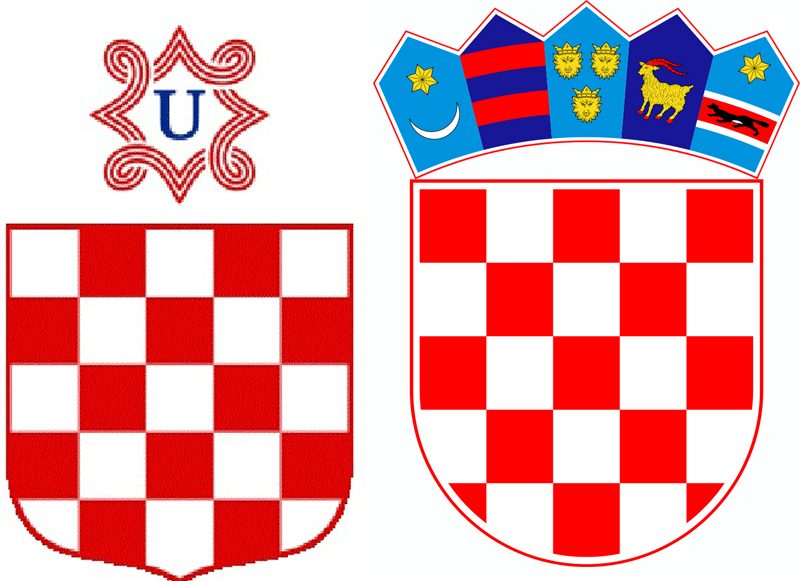
Anyways, another thing that irritates me is that there are both Croatians and Croatian emigrants selling insignia with the our Nazi Coat of Arms on it (the Ustaše--we were a Nazi puppet state in WWII so it is literally a Nazi insignia).
Just for reference, on the left is the Nazi (Ustaše) coat of arms [Note: often the "U" at the top is left out--it's Nazi insignia either way], while on the right is the Croatian coat of arms: https://dubokavoda.com/wp-content/uploads/2019/08/Grbovi-NDH...
Here are some listings on Etsy literally selling the Nazi coat of arms:
PART of croatian emigrants, now well into several generations away from their original exile following WW2, are a big disgrace and actively damaging modern Croatia which has zero things to do with Nazis and all that. It's a big issue and hot topic whenever it comes up locally.
With regard to the coat of arms, I’m familiar with this (or something that looks similar) from various Croatian football teams. Is this really a Nazi symbol? Or just a Croatian identity one, and the Nazi one they put a “U” on top of for Ustaše?
Croatian identity(coat of arms) is chessboard [0] it is 500 years old. Quasi Nazi symbol is Ustaše (U) but it was initially a movement for Croatian Independence later on it became Nazi like.
You described Croatia as a Pablo Escobar's Columbia where crime and corruption reigns and dominates everyday life but that's not the case. Yes corruption is high but that's the problem of Communist legacy. Many of the same state workers and politicians who worked in Yugoslavia are working for the state right now or their children are.
Lustration of Communist elite and state workers including judges didn't happen like in other East European countries.
Croatia in 2019 was visited by 20 million tourists and one of the reasons except "nature and beauty" is low crime and feeling of being safe. There are no street gangs and violent street crime over here.
>There is a saying in Croatia "Where were you in '92" that is reserved for the older population.
Btw it's 91 that's the year when the War started you probably confused it with Bosnia where the War started in 1992.
This is not "pressure being put on Wikimedia", it's the Wikimedia folks trying to re-establish/enforce the underlying principles of their projects, which have existed since these projects got started.
This ain't new, people tried to convince Wikipedia to do this for years. Wikimedia always claimed that there's nothing they can do about it. Turns out that was bullshit, as all of us knew.
And Balkan Insight is really fucking good at getting English speakers to care about problems in the Balkans.
The report quality is excellent and a worthwhile template for disinformation investigations in other contexts. I found it especially interesting because while I am not an expert in Balkan affairs, I'm expert-adjacent; have friendships with refugees, journalists and former military/intelligence involved in the conflict on various different sides and have read deeply into it in my own time.
A standout was the table listing relevant facts (specifically convictions of war criminals by an international tribunal) and whether the language sub-wikis accurately reflect those facts or not. Whether one likes or dislikes a given fact, its occurrence is a kind of ground truth that can serve as a reference marker by which to weight the factual content of an article. Thus, whether someone was convicted by a tribunal is a fact; whether it was fair is open to debate, but failure to mention the fact at all amounts to a concealment of information, whether negligent or willful. When we see a pattern of factual errors (including glaring omissions), we can assess the degree of deliberation involved by looking at whether the errors all run in similar directions and how systematic/assiduous the erroneous editor is in rejecting alternative points of view.
A complicating factor here is Wikipedia's general open-access policy. As you probably know, some people who are interested in a topic appoint themselves gatekeepers of it and revert edits they disapprove of. Over time, I can be difficult the distinguish between passion and expertise. For example, suppose you grew up in a village where a battle was fought (before you were born or aware of such things). You receive from your parents, peers, and teachers an approximate view of the historical event as experienced by those who lived through or were directly impacted by it. While in high school, you find a Wikipedia page about the battle which has some details wrong - geographical facts, say - and you correct those with your local knowledge. As time goes on, you become the leading Wikipedian curating this topic, and enrich the article with all kinds of valuable information on how the battle was fought.
But suppose you find yourself getting into arguments about why the battle was fought; now you're going outside the scope of your local knowledge. Battles might fought for purely logistic reasons (control a river crossing, cut an enemy off from supply lines), personal ones (a commander has family or reasons to love or hate a particular place), or strategic factors (to weaken enemy resolve or tempt a misallocation of forces). These might not be apparent from the local perspective; received wisdom might posit a local cause that was actually just the initial skirmish of a larger action.
Case studies illustrate some of the difficulties in evaluating controversial information. For example, the entry on Ratko Mladić, a Bosnian Serb, is heavily slanted on Serbian wikipedia, which emphasizes his positive qualities and plays down negative aspects of his story, as well as introducing analysis and speculation favorable to Serbian nationalist narratives. Now, a problem with bias accusations is subjectivity; a Mladić apologist might argue that other narratives omit contextual information that seems to justify his actions, or that emphasis on his criminality serves to distract from crimes by other parties that equally severe but less strenuously prosecuted.
Although there may be large differences of opinion, that can be OK when the contextual variations are truthful. Different people can have very different ideas about what the significant factors are, and exploring those differences can be valuable. Most historical arguments (in my non-professional view) are not so much debates about what happened but rather over what matters, and that can vary both because people are on different sides of a tribal argument but also because people have different assumptions about moral/ethical considerations that are orthogonal to their tribal membership.
Missing from the report (perhaps because most people are not that interested) is any kind of dynamic information about the development and intensity of the divergences. It might be interesting to mine the article history and/or talk pages to get a sense of which parties struggled over control and how those struggles played out - for example, was there an openly revisionist challenge on core topics that was eventually sustained by attrition of disagreeing voices, or a stealth campaign of incremental nudges in one direction with a large cumulative effect?Modeling and visualizing these dynamics could yield valuable insights on other sorts of networked conflicts.
While pretty much all mentioned wikis share same bias and mistrust towards them, apart technical articles... Proposed solutions make sense, except for
Encouraging the affected communities to discuss the possibility of re-merging Bosnian, Serbian and Croatian language projects into the original Serbo-Croatian language projects to re-align with the practices of other pluricentric Wikipedia language versions.
Which will not happen, and on top of it is border-line offensive and shows a dose of not understanding the differences. Serbo-croatian or Croato-serbian (as the full name of the language is) was an artificially constructed language during social-communist Yugoslavia. All involved parties agreed to part ways on unification of the languages for a myriad of reasons, not all political ones.. and that's now water over the bridge.. and now this entity, probably through ignorance, wants to offer re-introduction of the topic which countries have fought wars over? Nah. One of the reasons why SH (serbo-croatian) wiki even exists is because there's a group of people living in the past and which makes, for themselves, communities like that. Raisong the issue as a possible course of resokution and common ground not only gives legitimacy to it, but is border-line offensive and absolutely ignorant of the issues at hand.
Otherwise, apart from that, great. Something needs to haooen to ex yugoslavian wikis throughout to make them at least half-thrustworthy.
This is unfortunately complete baloney, and I really cannot find a better word. The differences between the languages are not greater than the differences between American and British English or German in Germany and Austria. In fact the language spoken by the Swiss cannot be understood by almost all Germans, yet it is still called German. The only artificial part are the names which stem from the inability to come to a compromise, e.g. neither side can accept to speak the language of the others. It needs one name because it is for all intents and purposes one language. Everything else is just politics. This view has recently also been supported by a group of linguists in the region, see: https://en.m.wikipedia.org/wiki/Declaration_on_the_Common_La...
I think you're missing the point. There seems to be endless discussion around this question, but it is purely academic and doesn't affect people who speak one language or the other in the least. It's irrelevant.
If (some significant number of) Croatians say they speak Croatian then these is a language called Croatian spoken by Croatians. It doesn't matter if it has a striking resemblance to another language or if it is unique. People have a right to linguistic self-determination as much as anything else.
The language you speak is entirely political. Academics or historians don't get to determine what languages people speak, people do that for themselves.
People, whoever they are, can speak whatever they want and they can take any position they want. Including that the Earth is flat.
But what I was replying to made a different claim, that a mutual language does not exist and was made artificially. This is objectively not true, and you can see it in practice (many examples available). The opposite is true: the differences are artificially magnified as a part of a political project, very similar to the actual situation on Wikipedia we are supposed to be commenting on.
The mutual language was made artificially, in the sense its naming was political. It was a political construct as much as the Croatian language is a political construct. They're not identical languages and people in general do not consider some exact degree of difference as decisive, even if (some) academics do. It's not like calling the earth flat since that is not a matter of degree.
For example, Dutch is derived from, and similar to, German as is Swiss German, but no-one is saying that Dutch should be called Dutch German, and the Dutch would surely vigorously object to that. Croatians have every right to reject the notion that they speak Serbo-Croatian or that such a language even exists.
Can you say there's only 10% difference between the two languages? Absolutely. Does that give someone the right to declare the languages the same outside of Academia? No. There is no objective standard to rest your claims of objective truth on.
Let's continue tying the Dutch into this discussion. The war crimes tribunal for the former Yugoslavia was in the Hague. One of the official languages there was BCS: Bosnian/Croatian/Serbian. Not three of the languages, but one of the languages. Can you imagine anything more damning than being charged in a court of law, and not understanding the charges? Fortunately this was not the case, as the languages are in fact identical. That a court of law sees them as identical is a very objective standard. There are many other examples.
You are also doing Croats a disservice by presenting them as a hive mind that rejects certain notions in unison. Some of them disagree explicitly that the languages are separate, and a lot of them disagree implicitly (if not most!). For example, only a couple years after the war there was a Serbian movie in Croatian theatres, and it was subtitled. This was met with widespread ridicule in Croatia, and the practice has been, as far as I know, abandoned. So even if people don't want to open this can of worms (that I unfortunately did here), when faced with the full consequence of it, a large number of them will find it ridiculous.
To be clear, I am a native speaker of this language, or if you wish languages. I also speak English and German, and have spent some time in Switzerland. I believe my experience is adequate to say that we are in fact speaking one language, and the differences are nothing more than regional differences, that exist everywhere else in the world.
Aside the fact you have linked to a declaration linked to political platform initiatives, one of the core serbian propaganda machinery during the 90's wars and breakup of Yugoslavia was denying identities and right for self-determinism across constitutive nations in said country. Prime example was (and is) throughout denial of montenegrin nationality and language, the other (among many) establishing a never in history existing one (not common base) language platform which would solidify serbian tendencies to tie-in languages and outside of its area, and thus people, into its own agenda. Our children, at least in Croatia, have trouble understanding a large volume of lexicography from swrbian language, and I am sure there's the opposite as well. Notable is the absence of Bulgarian in the story, which to a large extend is also understood by our yugoslavian-schooled peers, no different than macedonian or slovenian for that matter.
Any and all discussion around languages in these matters have started and stopped by politics and ultimately even supported by academia. Is there a common understanding and overlap between languages? Of course. Are there differences? Of course, and as time goes by they grow larger - new generations have no idea what the other one are talking about for a lot of even trivial examples. Whomevwr says differently either does not love in the region or lives in a bubble. Whether that's anecdotal or a docimented fact (exercise to a reader to find reactions in each country to said declaration that followed promplty lole fire from all levels from academia to politics in all countries) is a sideshow to the following: apart from yugoslavian period and a bit before there's no shared history (500+ years of ottoman empire does that to one part of the region whereas the other wasn't in it), there's no shared literature throughout history (since it's a wikipedia post, find history of croatian literature and then serbian), how come it's called serbo-croatian or croato-serbian excluding all other nationalities/countries (and how come it's only ex-yugoslavia centric?), and ultimately and the only unarguable reason relevant to the topic is that language is one of the key components to national identities which region has struggled (wars over) within recent decades - tha ultimate reason why this won't happen ever, as exemplified even by this small universe of replies within.. which was my whole point.
To add to that (as I guess many will not know this — I certainly didn't until recently), the group of dialects is called Alemannic German, and is not exclusive to Switzerland. There are similar dialects spoken in all of the surrounding countries — including, of course, Germany. Linguistically and historically it's part of the same language continuum as standard German, so the name "Swiss German" is not misinformative as some may assume from the fact that standard German speakers often can't understand Swiss German. There are other (probably many, though I only know of a few) similar examples of languages where people might assume the dialects are mutually intelligible, but they really aren't — Italian also being one. I suppose it's even the case in most countries/languages that there'll be dialects that are only barely mutually intelligible.
Native swiss here and would not sign that swiss german can‘t be understood by germans and that it is a separate language. Austrians and germans who live at the border can very well understand us and their dialects share many features with swiss german, more so than with some german dialects from the north. I think that categorizing swiss german as a separate language is very much an act of balkanization. It is part of the german language whichs spans a large geographic area with many different variations.
I speak German and as most others in Germany I do not understand Swiss German. My point was simply this: the similarities between those two are so tiny to a point that people who only speak one of those two would not be able to communicate. Yet they still find a way to put German into the language spoken by the Swiss. The differences between Serbian and Croatian are so tiny that people speaking only one of those would absolutely be able to understand each other. And this is true even after decades of partial isolation from one another.
Even stronger: the differences in internal regional dialects within Serbia and Croatia, are sometimes larger than the differences between official Serbian and Croatian (although even these small differences in official languages are often artificial and politically forced into).
That's true only for areas near border. Zagorje people will not understand a lot of things from Sumadija and vice versa, too many different words. Even Zagorje people will not understand a lot of things from Dalmatia and vice versa. Core difference being a standard language both Zagorje and Dalmatia share that they can use, a standard Croatian language. Same within Serbia, etc. If you need an example, there was one written ad hoc using the two standard ones as one of the reactions for that declaration. Both variants using everyday words and language, worda that do not really exist in others language dictionary or have other meaning... Whereas people near the border (or older generations) would understand most of it (I'm fourty and have learned serbo-croatian in elementary school and even I don't have idea about some of these words):
---
Imam automobil s dobrim strojem na unutarnje izgaranje. Krenuo sam u trgovinu u neboderu. Mislio sam, bit će tamo hljeb kruha i za mene. Nemam svoj vrt stoga kupit ću još malo sira, mrkvu, krumpir, špinat, raznog drugog povrća, gljive i tjesteninu, sve to ću staviti u posudu za kuhanje i u svom stanu na drugom katu skuhat ću dobru povrtnu juhu. Prljavo posuđe ću staviti u perilicu, a onda opeglati rublje.
Zamolio sam prijatelja u Beogradu da napravi isto, ali i da to i napiše. Evo kako je on to uradio.
Imam automobil sa dobrom mašinom na unutrašnje sagorjevanje. Krenuo sam u dućan u soliteru. Predmnjevao sam, biće tamo hleba i za mene. Nemam svoje bašče, zato ću da kupim još malo kačkavalja, šargarepu, krtole, spanać, raznog drugog povrća, pečurke i makarone, sve to ću da stavim u šerpu i u svom stanu na drugom spratu ću da skuvam supu od povrća. Prljavo suđe ću da stavim u mašinu za pranje sudova, a onda ću da opeglam veš.
> Even Zagorje people will not understand a lot of things from Dalmatia and vice versa
Right, but this does not make it different languages because I just made up a reason. These differences exist between all regions and in all countries. The differences between American and British English are even more pronounced. The differences between German and Swiss German are more substantial than the similarities etc. And even when the Swiss speak German for the Germans to understand them, there are differences, e.g. Fahrrad vs Velo, the construct "es gibt" vs "es hat". There are differences between German spoken in Saxony and Bavaria. There is nothing special going on in the Balkans, contrary to what a lot of people there think.
Most people will understand almost everything in the quoted texts, although almost no Serb will understand the quoted Serbian text completely. You will need a lot of luck trying to find a person in Belgrade who understands what "predmnjevati" means. I have no idea. No actual person speaks like this. There are other comical errors that illustrate what is going on here: artificial magnifying of the differences. But the only outcome possible for those that attempt it is to fall flat on their face.
This must be a comedy article, at least judging by the supposedly Belgrade version ("
Imam automobil sa dobrom mašinom na unutrašnje sagorjevanje. Krenuo sam u dućan u soliteru. Predmnjevao sam, biće tamo hleba i za mene. Nemam svoje bašče, zato ću da kupim još malo kačkavalja, šargarepu, krtole, spanać, raznog drugog povrća, pečurke i makarone, sve to ću da stavim u šerpu i u svom stanu na drugom spratu ću da skuvam supu od povrća. Prljavo suđe ću da stavim u mašinu za pranje sudova, a onda ću da opeglam veš.") which I attest is not written by anyone living in Belgrade, nor Serbia.
What gives it out is that, although it mainly uses "correct" words, with some obvious slips, makes some pretty obvious gramatical and ortographical errors. I guess that it's written by a Croatian journalist, who obviously can speak, read, and write "Serbian" rather well, but who wrote several things wrongly because he imagined that Serbian uses these distinctive features. I can attest that I understand all words in the "Croatian" version without any help, and that the "Serbian" version sounds closer to what is spoken in Belgrade, but only to an extent (it sounds silly and artificial to my ears).
Really, all languages are basically the same language. Draw a circle around any <del>50km</del> 5km area and almost everyone in there will understand each other, with only minor differences in speech.
Think this is wrong? Okay, then: English should be divided into Romantic and Germanic. It's two languages (basically French, and basically Dutch) that have been mashed together, with a splash of Celtic influence.
Here is a quote from the late Serbian linguist Ivan Klajn:
"Experts have the viewpoint that if 70 percent of the words between two languages are common, then they are not languages but variants of the same language. And in our case it is not 70, but over 90 percent".
Okay… but then where do you draw the boundaries between the Germanic languages? What constitutes a language will always be political, until the day we stop drawing borders between languages.
Try playing a German movie without subtitles to an English person and then do the same with a Serbian movie and a Croatian person and you will have your answer.
People either understand each other or they don't. There's absolutely nothing political about that.
Try playing a German movie without subtitles to a Dutch person, and then do the same with a Geordie movie and a Yankee.
Speaking of… Wikipedia (Dutch):
> Wikipedia is een online encyclopedie die ernaar streeft inhoud te bieden die vrij herbruikbaar, objectief en verifieerbaar is. Het project is gebouwd op vijf zuilen. De Nederlandstalige versie startte op 19 juni 2001 en is, gemeten naar het aantal lemma's, met meer dan 2 miljoen artikelen de op vijf na grootste taalversie.
And Wikipedia (German):
> Das Ziel der Wikipedia ist der Aufbau einer Enzyklopädie durch freiwillige und ehrenamtliche Autoren. Der Name Wikipedia setzt sich zusammen aus Wiki (entstanden aus wiki, dem hawaiischen Wort für ‚schnell‘), und encyclopedia, dem englischen Wort für ‚Enzyklopädie‘. Ein Wiki ist ein Webangebot, dessen Seiten jeder leicht und ohne technische Vorkenntnisse direkt im Webbrowser bearbeiten kann.
Different languages. Neither is too hard for an English speaker. (If in doubt, try pronouncing the words.)
While I'm at it, Wikipedia (French):
> Wikipédia est un projet d’encyclopédie collective en ligne, universelle, multilingue et fonctionnant sur le principe du wiki. Ce projet vise à offrir un contenu librement réutilisable, objectif et vérifiable, que chacun peut modifier et améliorer.
Also a different language! But just you tell me you don't understand that.
Play any Serbian/Croatian/Bosnian movie anywhere in Serbia/Croatia/Bosnia, and nobody would need any subtitles; that's the point. In Croatia, they (sometimes?) subtitle Serbian movies, for great comic effect.
Many different languages are mutually intelligible. Many dialects of the same language are not mutually intelligible. That's because the ways people speak don't divide up neatly into languages.
I'd like to invite you to Belgium, a trilingual country. And no, here a lot of people don't speak all three (nor even the major two). French and Flemish are not close to each other at all.
Your comment sounds fine on the surface, if you don't actually stop to think about it. It's horribly wrong in lots of Europe, Africa, south America and Asia, hell even in the US it's not correct everywhere.
Yeah, it's only really true of the Germanics (and English with the basic vocabulary of a few languages, because English is weird) – but even then, questionably.
Serbo-Croatian is a family of very closely related languages. There are some differences in lexicon and script, but there are also differences among varieties of English. And you could write English down using a different script like Devanagari, but this would not somehow make it into a different language.
> There are some differences in lexicon and script
Even this is only to a point; namely, all these languages use Latin alphabet, while Serbian also uses Cyrillic (Serbian uses both alphabets). Croatian originally used Glagolitic script (many centuries ago). This Latin/Cyrillic division is caused by Catholic/Orthodox church split and Habsburg/Ottoman empire border rather than being some central feature in languages.
Certainly the naming of the language as "Serbo-Croatian" or "Croato-Serbian" happened in the Socialist period, but the Serbian, Croatian, Bosnian, Montenegrin, etc. etc. languages are really variants of a polycentric language [1], whatever you want to call it. For those not from the Balkans, imagine the British, Americans, and Canadians insisting that their versions of English are completely different languages, or making up new words to distance themselves from each other.
Snježana Kordić's book made the case that there is a polycentric language shared by those countries and that much of the current politicking over this topic is nationalist in basis. I think it's easy to see that this bickering over language is yet another useful distraction from the catastrophic state of society and the economy in those lands.
I am Croatian and I don't understand what's the problem? Croatian admins are probably patriots who want to protect our country from the past Communist ideology and defend our War of Independence.
I'm sure US admins are patriots as well for example and are proud of their War of Independence and all the good things that US has done in the past while at the same time being critical of all the bad things that happened in the past.
After all Wikipedia should be facts not opinion articles but of course there is always some commentary on top of facts which can be ideological.
In Croatia there is Culture War going on between the Left and the Right for the last 30 years but that is democracy. If we all think the same then nobody is thinking.
Why is Croatia singled out and not Poland for example? Poland is more "right" than Croatia and over there we can see intense and sometimes violent confrontations between left and right.
The problem is that a cabal of people subverted the processes of Wikipedia to gain effective control of the Croatian Wikipedia, and used that control to exclude opposing viewpoints entirely and in some cases insert and preserve completely counterfactual content.
That is what is being "singled out", not their political ideology.
Every time when I read Croatian Wikipedia I see facts I mean historical facts. Commentary on top of facts can be ideological but facts are facts. From the Wikipedia report I can see topics of WW2 and War of Independence being problematic but I read about these topics on Croatian Wikipedia and I didn't see any "counterfactual content".
And like I said Wikipedia is not about opinion articles it is about factual information.
They are interested in truth that's why they are defending our history and speaking up against leftist propaganda. Who they can fool and influence with so called misinformation?
Foreigners don't read Croatian Wikipedia and majority of children and young people don't scroll Wikipedia articles they scroll through Instagram and YouTube or any other internet social network.
After all our history books and our Constitution should be the source of reliable information not crowd-sourced Wiki website.