> In a recent job listing for a property-and-casualty insurance agent, TGS laid out those expectations: “If you’re just OK with getting by, or are a ‘quiet quitter,’ this will be too fast paced for you. We’re looking for people that want a new Mercedes.”
No wonder they aren't inspiring Gen Z. A Mercedes isn't a status symbol for Gen Z, and it barely is for Millennials.
I'm glad to see people recognizing the emperor has no clothes. Sacrificing yourself for a company you don't own--at all, never mind completely--won't make you wealthy. The company wouldn't employ you if you weren't providing them more than you cost them. It's never been easier to create enough value on your own terms to sustain yourself and not let someone else siphon out your value on their terms.
> I'm glad to see people recognizing the emperor has no clothes.
The COVID shutdowns exposed the lack of loyalty (possibly humanity too) on the side of employers. Additionally, most employees have internalized that it's sometimes better to be unemployed while up-skilling than to maximize raw employment time.
This is blowback for companies treating employees as disposable, but acting surprised when employees catch on and start to see such jobs as disposable too.
Perhaps your employer received money from the pandemic “corporate giveaway” bills that were passed? Or perhaps they are a rare breed that choose to willingly lose money?
Either way I see no evidence that there are “a lot of companies that did everything they could to keep people employed” when it meant them losing money or not benefiting from corporate government welfare to keep people employed.
Recruitment also costs a lot. There is the visible fee when you use headhunters or even ads. Bur there is the not visible cost of internal effort (that could be used elsehwere) and lower efficiency before everyone gets onboarded.
And mine (at the time) cut everyone's pay by nearly 30% with almost no notice, then acted like they were doing us all a solid by putting everyone back to where they were almost a year later without making us all do performance reviews first.
In my experience there are more employers like mine than yours in the world.
> The company wouldn't employ you if you weren't providing them more than you cost them.
This is a stabilizing (therefore desirable) feature in the system, not a bug. I want that (and work hard to ensure that) my company receives more value from me than I cost them. That makes them want to retain me in a stable relationship that benefits both of us. I don't want their surplus to be too great, but I want there to be a definite, undeniable surplus on their end.
The alternative is far worse: if you are costing the company ore than the value you're providing, a rational company should fire you to improve their company. That they haven't means you're working for incompetent leaders in the best case (and leaders who are about to fire you in a worse case).
That’s easy to say when you take home 300k and the company generates 600k of revenue per employee.
It’s totally different when you are making $18 / hour and the company calculates your value at $19. Screw up a little bit your done. Push you to work extra for free and they just doubled your net value!
Some people look at this and think "yeah man the company is terrible!" and some people look at this and think "what do I have to do to make $300k/yr instead of $18/hr?"
You want the company to make more revenue from you than you're costing. I agree with this, and try to keep this balance myself in my job.
> The alternative is far worse: if you are costing the company ore than the value you're providing, a rational company should fire you to improve their company. That they haven't means you're working for incompetent leaders in the best case (and leaders who are about to fire you in a worse case).
I think the big problem comes from this largely overlooked next part. Companies are rarely rational. Some leaders will keep people on staff just to show that they are a big team. Some leaders have cronies. Some are just super incompetent themselves; and seem to use the Dilbert Principle [1] as a guiding light by promoting their incompetent cronies or flatterers to high positions. Often, they will snare workers in a lot of make-work tasks while awarding huge bonuses to themselves. Anyone in management is rarely fired -- you will often see managers who have been at the same job for 20 years coasting by just as much as, if not more than their employees.
It seems to me that the overlooked part of "quiet quitting" is due to workers noticing this sort of problem in their management; and taking that into account while deciding how long they work.
And, oddly enough I don't think this is at odds with what you said -- basically, the more irrationally a company seems to behave, the more they will get people who want to coast since they realize the irrationality. I feel like a good way to right the ship is to promote a lot more rationality into management; and quickly get rid of managers who seem toxic, prone to cronyism, or having a lot of attitude about "these people work for me".
----------------------------------------
[1] https://en.wikipedia.org/wiki/Dilbert_principle, says (semi-humorously) that the most incompetent people usually get promoted to management to prevent them from doing more damage in IC positions
But this assumes your only option is employment, which is exactly the opposite of my point.
If, as another commenter said, I'm generating $600k of value and only being paid $300k, it's easier now than it ever has been for me to reduce my effort and generate, say, $450k, and still get to keep $300k of it working for myself. I can reduce my output my 25% without reducing my income.
That's not to say it's easy, just easier than it ever has been, and people are figuring that out.
The other commenter posited $600K of revenue, which is not value. The absolute cap on direct value would be revenue times contribution margin percentage. If the CM% for your company is 60%, they're making a CM of $360K on the marginal $600K of revenue while paying you $300K.
If you reduce that $600K to $450K of revenue, the CM becomes $270K while paying you $300K, meaning a rational employer should fire you.
You're missing the whole point again, which is that by leaving the company, you don't have to produce as much revenue or value for you, yourself, to RETAIN the same amount of money as income.
Yes, a company should fire you of you reduce production by 25% and require the same payment. But the whole point is that all these people are figuring out they don't need the company for their income as much as the company needs them for the revenue they produce.
This assumes the company knows how to value your work. I started my career in operations working at companies that pioneered working in public clouds. What this meant was long weeks, missed sleep, and thankless work. I saved the companies millions per year through improved resource allocation, high uptime, and fast deployment cycles.
Invariably, company management viewed the above as an expense to incur only as long as infra was percieved as a problem. In my third year of experience I had a banger of a year at a startup and could rightfully claim 3 million per year in savings. In uncertain terms it was implied to me that I wasn’t expected to stick around for the second year but I was given a 2% raise out of kindness :shrug:
Management generally views themselves as valuable, and finds people like themselves as valuable. I got wise to this and transitioned fields.
Exactly my experience in ops as well across very different industries. Ops feels like a stain on my career at times, bizarrely.
The past was no picnic, but I know there was better respect towards the workers in decades gone by. I remember a “how to get rich” book from back then talking about not hiring or contracting the absolute cheapest bid, believe it or not. It preached making sure your side of the deal didn’t come at an unfair cost to another side. Believe it or not.
The long timers in LV who had worked in both the mob days and corporate america/modern had a strong preference for working for the mob. That should tell it all.
key word "evidently" ... you have to ensure it's evident to the evaluators, or find different evaluators .. maybe even make yourself the evaluator by starting your own thing
An adjacent field that was higher value. I’ve made a bit of a career transitioning fields and now work on a mix of ml and database internals at a large tech company.
>The company wouldn't employ you if you weren't providing them more than you cost them.
Yes that's true of course.
>It's never been easier to create enough value on your own terms to sustain yourself and not let someone else siphon out your value on their terms
Not so sure about that part. Maybe it's easier today but if you mean things like freelancing the problem is that you then have to do lots of stuff that isn't interesting to a lot of technical oriented people (like finding clients, negotiating contracts etc). The advantage of working for a company is that you can concentrate on the things that interest you and leave the rest to others.
Sure you'll end up earning less but, in my book at least, its worth it. But nothing says you have to "sarifice yourself" you can work for a company but still have a decent balance to have time for other things.
I feel like the 'capture all the value you provide' type comments come from those who have never run a business or worked independently, or maybe they did and got extremely lucky.
For most, it's way more work handling all those tasks you mentioned, in addition to the work you 'are getting paid for'. The stress alone is killer.
In our industry, it's hardly serfdom: I have reasonable autonomy, get paid vacation time, and can largely code (my preference) the bulk of the day.
Speaking for myself, I disagree with OP. I have a price for nights, weekends, and overtime. That price, however, went up beyond the average salary. Second to that, even if they do want to pay that money it needs to be in writing. No amount of lip flapping will get that out of me. I have goals and those goals require money. They either pay, or I do what I'm paid to do. What I'm paid to do is still a good and needed job. From my perspective, workers learned their value.
There's a big difference still between "easy" and "easier than it ever has been."
Rather than having a company with gazillions of layers of management tell me what my options are for everything outside of the work that is my direct responsibility, I can choose which things I care about and how much and pull those levers myself, either doing them or hiring them done.
"The company wouldn't employ you if you weren't providing them more than you cost them."
Ah sweet summer child. Even if your 1st lvl logic would hold they would ditch you if your replacement + replacement cost was less than yours. But never mind. Companies have limited and wildly inaccurate information regarding your value and contributions. But even worse, "companies" do not make hiring/firing decisions, people do. And people have not only extreme irrational behaviors, but even when they act rational they act in their own interest, not "the company's", and the larger the company, the less causally aligned these interests are.
All you've said is the same thing I already said, but you spelled out the "opportunity cost" part of the equation separately, while I assumed everybody knew that was part of the consideration and didn't need to be spelled out.
Obviously the entire thing has a big "in their assessment" caveat around it too. This is also* part of the problem, not anything that negates what I already said.
My perception (though I was not alive for this first part) is that there was a shift from giving a shit about your employees and wanting them to have good lives to not giving a fuck about employees if it meant saving a buck. And it took a long time for the culture to catch up.
> The company wouldn't employ you if you weren't providing them more than you cost them.
That's not really true - figuring out contribution value is really hard in a lot of cases, they could be overstaffing for expected growth, keeping you off the market for competitors, could be for political reasons etc.
Millions of reasons why you could be on the payroll but not pulling your own weight.
> The company wouldn't employ you if you weren't providing them more than you cost them.
Well yes, but actually no. "The company" has no idea how much value you provide, and even if it did, the value you provide to "the company" and the value you provide to your immediate management chain (who is likely to make hiring/firing decisions almost autonomously at the IC level) are entirely different. Empire building is the first thing that springs to mind.
I think the mass exodus of employees is proving that they were not ending up better off, or at least not nearly to the extent their employers were. That's precisely the point.
IF both parties were actually better off, people wouldn't leave and stay gone. They might strike out, thinking the grass was greener, but they'd be back in short order.
That they're leaving and staying gone shows that the reality wasn't living up to the theory.
Money isn't the only measure of value either, though. If they thought they were ending up better off on the whole, they would come back.
They've clearly concluded they're better off now than before, across whatever factors matter to them, so again, the reality wasn't living up to the theory.
Them staying home is showing that it is a reality. If they went to work even when it was a shit deal then that would show the theory didn't hold, but the fact that as the job gets worse fewer want to do it shows the theory works.
Yes of course: when the exchange doesn't make you better off, you don't make the trade. And the Great Resignation is a sign that plenty of workers are looking for better exchanges than they had been getting.
That changes nothing about my point though--if your employer was getting exactly the value they were paying you, they would be indifferent to keeping you employed. And vice-versa.
Esp for a "property-and-casualty insurance agent" role, which presumably is high volume, high stress, and is about screwing people out of insurance payments.
>I'm glad to see people recognizing the emperor has no clothes. Sacrificing yourself for a company you don't own--at all, never mind completely--won't make you wealthy. The company wouldn't employ you if you weren't providing them more than you cost them. It's never been easier to create enough value on your own terms to sustain yourself and not let someone else siphon out your value on their terms.
I want maximum money for myself not making less money so I can make some philosophical point about other people not siphoning value from me. If a company pays me that money then I don't really care how much money they make (aside from when I'm negotiating for more money from them). If something else pays better, without additional cost such as shitty healthcare or a lot of tasks I hate doing, then that's the way to go but not due to caring if someone else also makes money or not.
Sure. The whole point is that people are, en masse, concluding that they do not derive more value from being employed by a large corporation than they do working independently or on a smaller scale.
Many people factor other values into their consideration than raw dollars, but since value is subjective, it's their prerogative to do so and yours to value only money if you wish.
It's not about some self-righteous desire not to produce value for anybody else. It's about a realization that you can derive maximum value without the corporate employer.
>The whole point is that people are, en masse, concluding that they do not derive more value from being employed by a large corporation than they do working independently or on a smaller scale.
Are they? According to the BLS the percentage of people who are self-employed is lower than it was 2004-2006. It increased during the start of covid but hasn't gone up since then.
Going from "we don't want to put as much effort into corporate jobs that won't reward us for it" to "we want to be self-employed" is a big stretch that numbers don't justify.
Why shouldn't you? It's a comfortable car with lots of bells and whistles. From personal experience, it is much more pleasure to ride inside one, compared to cheaper cars. I think it is also much more pleasure to drive one (I don't drive, so I can't tell for sure)
I'm sure there are some people for whom driving is "an experience" and worth spending lots of money on.
For most of us, it's just how we get places, and there's not a big enough difference between how comfortable I am with a carful of screaming kids in traffic in a Toyota vs. a carful of screaming kids in traffic in a Mercedes.
Driving isn't an "experience" for Gen Z. Being a passenger certainly isn't. They barely look up between getting in the car and back out. They're not even going to notice the features of a Mercedes.
Well, one of the feature of the Mercedes is a very smooth suspension. It is much more convenient to type on the mobile keyboard while onboard of such a car. I think Gen X really should notice that.
A friend had a 20-yr-old Merc, it was about 1990 model so he had it in 2010. When he gave me a lift in it , it did indeed have a nice smooth ride. Being 20 yrs old, it had the added benefit of not costing a s** ton of money and therefore he didn't have to work for a soul-sucking sweatshop to afford it. ;) It was also still reliable, unlike modern Mercs (if anecdotes are to be believed)
The difference between a cheap car and an expensive car has gotten drastically smaller in the last 5 years.
Look at the features and interior of a modern Civic or Corolla. The software is as good as it gets, the quality of materials and fit an finish are as good as what a BMW or Mercedes was a decade ago. A GR Corolla has 300 HP and tons of torque.
Expensive cars just don't make as much of a difference as before.
Oh, I certainly appreciate being in one. Much more quiet and less bumpy.
But one doesn’t need to own or event rent a Mercedes for that.
While I can see how it could be reasonable for a professional driver to use such a car, I fail to see how it makes sense for most other (non-ultra-wealthy) people.
And making owning any specific thing, especially such a generic one, into some sort of personal life goal really is beyond me.
If you use the car every day (as, I believe, most people in the US do) - there is a strong incentive to invest in the quality of that part of your life. Like, everybody understand why you need good bed frame, mattress, pillows and bedsheets. I mean, I can, of course, sleep on a fully synthetic bedsheet, which feels like part of some goods packaging, which I had to do recently. But my oh my, I won't do that again deliberately.
Mercedes is not a status symbol for Gen Z only because Gen Z generally just can't afford a Mercedes. Therefore for Gen Z a pair of sneakers is a status symbol.
Do you have any reference showing Gen Z wouldn’t think a Mercedes is a status symbol? The Zoomers I know are the most materialistic human birthed yet, they just don’t have a way to get a Mercedes. But if they did…fr fr bussin’ on their friends immediately with it.
One thing I love about their ad is it reminds me of this classic speech by Alec Baldwin in Glengarry Glen Ross. Same tactic, different decade.
> The bad news is - you've got, all of you got, just one week to regain your jobs, starting with tonight. Starting with tonight's sit. Oh, have I got your attention now? Good. 'Cause we're adding a little something to this month's sales contest. As you all know, first prize is a Cadillac Eldorado. Anybody want to see second prize? Second prize's a set of steak knives. Third prize is you're fired. You get the picture? You laughing now? You got leads. Mitch and Murray paid good money. Get their names to sell them! You can't close the leads you're given, you can't close shit, you are shit.
It’s difficult to articulate but something as pure symbol of status as Mercedes is actually low status. Tesla, which is also an environmentalist symbol, is high status. This is an example of a pattern.
I would argue that Tesla is losing ground as a high status symbol, at least in the Bay Area. They certainly don't turn heads anymore, it's now Rivian, Lucid, Taycan, Ioniq 5, etc that are the talking points in the fancy grocery store parking lots.
What matters isn't the specific brand or even what they're selling, it's that it's The Cool New Thing.
The tech bro demo in SF loves high tech electrical stuff, and Lucid, Rivian, Taycan, etc. are, COOL and NEW and align to their political and social sensibilities, while also allowing them to flex the conspicuous consumption and signaling.
Mercedes is not new and does not align to obvious socio-political ideals outside of $$$$.
This is also mid-level bling in the grand scheme; the big money is still driving Lambos
I think that view might be some of the same generational (and cultural) mindset misunderstanding.
Fixations about cars (literally, or as a proxy for income), or about "our people", or "good families", are largely disappearing in the cohort of people who are starting careers and families today.
This trend started 60 years ago in the US, and is finally fully mainstream today, even if some parents are still holding on to the past (and if some communities are slower than others). But thank goodness for the progress, at least!
...
But the super-out of touch part of "new Mercedes" is that, even among the status/materially-motivated members of younger generations, a new car, and certainly a new Mercedes, ain't it.
"We want people who want a new Chevy! .. I mean, a new Lincoln! Cadillac? Camaro? Lotus? Mercedes? BMW TT? Prius?! Tesla?? Rivian??? Oh Jeez stop making it so difficult for me to sign up you kids to make me richer already!"
> This trend started 60 years ago in the US, and is finally fully mainstream today,
I assure you it’s not unique to desis in the US.
> even if some parents are still holding on to the past (and if some communities are slower than others). But thank goodness for the progress, at least!
It’s sad how many desis confuse “being more like white people” with “progress.”
Sure, I agree that it's not unique to the US. And I'm not trying to suggest that US/Anglo culture is superior in any way.
But I would suggest that children living their parents' lives, or for their parents' approval, is a recipe for deep dissatisfaction, unhappiness, and lost opportunities for many many people.
Some communities impose their "traditional" (usually hierarchical and patriarchal) expectations on the next generation more strongly than others.
And I would characterize moving away from those kinds of traditional expectations, as progress toward a more (difficult, but) chosen and intentional life. And I would call that a good thing.
> And I'm not trying to suggest that US/Anglo culture is superior in any way.
But that’s your ultimate point.
> But I would suggest that children living their parents' lives, or for their parents' approval, is a recipe for deep dissatisfaction, unhappiness, and lost opportunities for many many people. Some communities impose their "traditional" (usually hierarchical and patriarchal) expectations on the next generation more strongly than others.
In desi culture, it’s very important that children follow the right track, which their parents understand, instead of their own impulses. This cultural disposition is conducive to success—desi children are far more successful in American society than American children from similar economic backgrounds.
It’s also a recipe for contentment. You assert that living for what parents wants makes kids unhappy, but it seems to me that it’s American kids, who grow up being told to “follow their bliss,” who end up unhappy when their silly and unrealistic dreams fail to materialize. If you look at the statistics, from suicides to drug overdoses to cratering family formation, the western approach isn’t going that well.
> And I would characterize moving away from those kinds of traditional expectations, as progress toward a more (difficult, but) chosen and intentional life.
Individual “choice” is a distinctly western fixation. Worshiping the impulsiveness of youth over the judgment and experience of elders is a western fixation. It’s sad that so many desis conflate “being more westernized” with “progress.”
The "right track", you say. And parents know better. That's pretty self-serving, don't you think?
Self-determination and the ultimate responsibility of children to outgrow the default acceptance of their parents' belief systems are the absolute rights of every generation. Some communities acknowledge that fact, some encourage it, and some hide from it. Hiding won't make it go away.
Anyone who holds them back is committing an injustice against future generations.
It's not measured in economic success. That's a plainly myopic point of view. Freedom of activity and of thought is very noisy stuff, and it necessarily includes some failures. There are parallels to other systems of control exerted upon others here too, i.e. governments, etc. The seeds of those failures live in every community, they just are not dealt with as honestly in some.
The paternalist-authoritarian impulse to constrain the next generation's path is just old people not being able to admit that they don't know everything. This is like the landed gentry model of democracy. This way lies the death of the mind and the spirit.
Remember we're talking about overbearing parents having opinions about what brand of car their child's (inevitably, their daughter's) suitor drives. This is a trivial case of the parents' belief system failing the child. There are much more dramatic cases, of course, springing from the same self-serving impulses.
Financing is so readily available, that so long as you have stable employment, I think it is possible to procure most "luxury" cars, regardless of income. Whatever status symbol it may have conveyed as to wealth has been greatly diminished without going for the extreme upper end.
Spoken as someone who hates the necessity of owning a car. To me, it is a mode of transportation and that's it.
This is a false assumption, because some people definitely are. What is the real point of your statement? That you are not interested in opinions of such people?
Sure. You shouldn't care about the opinion of anyone who cares what car you drive, because they are, as made clear by that opinion, entirely superficial thinkers.
There's a comment higher from here that expensive car is a good proxy signal of wealth. Preferring wealthy people may feel unjust and even obnoxious, but it is definitely not superficial thinking. I personally would too steer clear (pun intended) of people like that, but just discounting them looks like the same behavior, isn't it?
At least where I live, what car you drive has mostly come decorrelated with wealth. Obviously at the extremes there’s still a relation (the guy with the beat-up 1990 civic is probably not rich, the girl with the $120k AMG wagon is), but is a new Tesla 3 driver richer than the person with a 2005 Subaru Outback? Who knows!
You might be thinking of counter-signalling on one hand. On the other hand there are just different groups of social status as well. To one group, a mercedes might be very impressive, to another it might be your time spent overseas, even if you all make the same money.
I think the reason cars might not be a reliable status symbol anymore is debt. If someons is in my socia-economic group but driving a very expensive car, it signals to me that they loaned the money so that they could have the status symbol.
Counter-signalling partly explains why pure status symbols are not among Gen Z. Taste, or aesthetic sensibility, is also an explanation. An expensive watch, such as a Patek Philippe, is still status since it's durable – to be passed on. A Mercedes? Not so much.
I also agree on your last point. Most young people today are unable to afford a home, or even pay off college debt. Wealth distribution is increasingly fat-tailed.
How is a Tesla an 'environmentalist symbol' when it has a 500kg battery with lithium mined from the global south and shipped around the world in the supply chain to add value?
> Many workers say they see little connection between working hard and being rewarded.
This has been my experience, and my personal theory to explain this change in productivity is that it's taking younger people in the workforce less time to figure it out than it took people my age. There normally comes a time around middle-age, when you say "I've been working like a dog for 15 years now, and what has it gotten me, and what good has it done in the world, and how much worse would it be if I coasted from here on out?" Now that's happening a few years sooner. The pandemic probably accelerated this introspection.
> An ADP Research Institute survey conducted in November 2021 found that U.S. workers said they were doing 8.4 hours of unpaid overtime work each week, down from nine hours the prior year.
Definitely happening much faster than middle age. My friends and I have realized this and we're <25.
One of my friends busted his ass the first year he started working, got an average performance review. 2nd year he chilled out a lot and got a better performance review. Performance reviews at most companies are useless and it doesn't take long to figure it out.
Another friend told me that it's not possible to get the top performance rating in his company. They just don't give that rating out.
My take is that a lot of Gen Z are entering the workforce and thinking "you expect me to do all this work for an ok salary I will never be able to afford a house on? that's a bad deal".
Manager here. I'd like to offer a plausible explanation for your friend's performance reviews. I tell my reports that I don't want them busting their asses or anything else, because that leads to burnout, which leads to falling behind, which makes them think they have to bust their asses to catch up, and it becomes an unhelpful cycle. Is it possible that your friend, after a year's experience, figured out ways to work more efficiently, so that they were more productive with less effort? That tends to happen when we strengthen muscles, and it also happens once you've gotten your bearings in a new role.
More likely if you stop paying attention to what needs doing, and more attention what your boss wants to see, you get a better review, regardless whether your boss is incentivizing business/customer needs or not.
Yeah I see so many areas where things need doing but they are unpleasant and provide no incentives for completion. Yeah they worked return 5-10x but that’s not something anyone cares about. Even worse if you get caught doing unpleasant things you will get punished by having to do more of them. It’s a loose loose proposition
I'm sure he did get better at working, but he himself said to me he cared less and was surprised about getting a better performance review. He has very little supervision/management. I doubt the company has a good understanding of what he does.
> Performance reviews at most companies are useless and it doesn't take long to figure it out.
Not just useless but political and down to interpersonal relations more than they are to actual work.
I used to work for a major tech company that would have their employees write a plan for each year. It would be agreed and signed off by your manager.
At the end of the year you were supposed to use this as a template to see if you had achieved your goals, and that would be part of some sort of grading which would affect any bonus, promotion chances and any pay rise you might have coming that year.
Only, in between the two the year would happen. Business realities and management direction would change, and what you did bore little relation to what you planned to do. So instead of you being graded on how much of your plan you had achieved, you were graded much more fuzzily, usually on how much the manager liked you or how much you made them look good to their superiors. I'm not saying this out of bitterness either, I was usually one of the more favoured ones.
When I had a few years under my belt I decided that it was much easier to be a contractor and opt out of all that sort of ****
Boss: You did a good job this year, really appreciate the effort.
Serf: Well, golly thank you boss! Have I noted how great your hair is? Or how well you crack the whip? I surely would not have been as productive had you not been overseeing me with such zest.
I have spend the past 15 years working in early stage startups, and I have never experienced a company with more than 30 people that were not doing annual performance reviews (mostly superficially just to tell investors that they were doing them).
So I have to question the validity of your anecdote. And even if you HAVE completely avoided any going-through-the-motions performance reviews, because you're working only for SUPER-early-stage seed round startups, then well... there are plenty of disadvantages to that life too. Not the least of which is that rising interest rates will likely be choking off the 15-year private equity gravy train cycle this year.
My experience might be abnormal but do most people not have to do their own annual performance review, with the "reviewer" just skimming it and giving a rating based on what they understood of your attempt to condense a year's work into a 500 word essay?
A formal review process at least surfaces those thoughts. It’s better than the quiet process where managers form their own conclusions without communicating them.
Small ones, where everybody knows everybody else. Below a certain size you don’t really need a lot of larger company ceremonies because there’s nowhere to hide, either you deliver at the expected level or it very quickly becomes apparent.
This. And thats exactly my case. You have a deadline and you just commit to that. We as a team always "judge" or analyze in a constructive way our own job, we are adults and we know our flaws and our strenghts, once we delivered a job we ask ourselves what could we've done better, etc. So there's no need of corporate bullshitism and arbitrary reviews.
Companies that humanize their employees won't reduce them down to a single review that only cares about the previous year and not the sum of their work. And yet we've normalized the former for some reason.
How do they ensure that rewards (promotions, salary increases, bonuses) go to people delivering value to the business and not those who are friendliest with management?
Huh. There are places that ensure actual effort results in salary increases, promotions, and bonuses? I seem to get better results when I work at a good level but without obviously putting in exceptional effort, to be honest. I wonder if this is shared by others?
Are performanxe reviews viable if your company wants to have your employees to cooperate with each other?
Individual performance reviews reduce incentives to cooperate, because you only need to have a good review in comparison, not on some non-existent absolute metric.
Yes they are. In fact, one’s performance objective in many cases depend on effective teamwork with one’s peers. And then there are the behavior part of performance reviews where you’re graded on intangibles like teamwork, trust-building, etc…
Performance review systems will always have flaws, but it’s better (in nearly all workplaces) to have a formal and transparent process for them than to have none at all.
I once saw a book written by a former HR manager who states, performance reviews are not really used to get better performance. They are ways for organizations to get documentation to fire you without getting sued for it, if they need it. HR’s job is to protect the company, not to protect the employee.
Yes they're valuable. Working together with your team is a core skill that everyone needs to have to be a professional developer, and as such is a major part of the reviews I do. Any good leader will encourage cooperation over competition.
I've been having on and off conversations with my manager and her manager about career aspirations. I'm at a terminal level, so I can hang out where I'm at as long as I want. What I didn't tell my managers is the promotion game sounds like a lot of work for 6 months to a year for a possibility that I'll get a job with more work I like less and somewhat more pay. You also start running into the issue where big companies only need so many super senior engineers, so you can't play that game forever. You're also playing it against people who will play it forever because the title means something to them.
If I worked hard and wasn't rewarded for it, my conclusion would be to switch employers—not to cut back on my work ethic.
Working hard has basically made my career. I'm not substantially smarter than most of the people I've worked with, but I got rapid promotions basically exclusively from going above and beyond.
I respect not everyone wants to do that, but it's concerning that people increasingly don't even see the value in caring.
> "I've been working like a dog for 15 years now, and what has it gotten me, and what good has it done in the world, and how much worse would it be if I coasted from here on out?"
you just exactly described me, exactly 15 years. a lot of sleepless nights dwelling on this.
why do this for another 15, will never afford a home, my savings will be worth -50% in 15 years of what they are now.
i feel like i have to do something different but stuck on that first step. if it was that easy and so on...
Funny to hear this sentiment in a tech forum. If you do well in a programming career you can afford a house almost anywhere. I don't think you need to work more than 40h a week to achieve that either.
I'm doing well in my programming career and a house in the majority of Canada is completely unattainable unless one partners up, or moves somewhere absolutely dreadful, which is the option I took and now regret.
Maybe this is true in America, but many of us don't live there despite a desire to do so.
Spending 30% of your income on your mortgage is pretty close to what lots of people in the US do. The typical advice is that you shouldn't spend more than 28% of your gross on your mortgage.
That’s minimum wage in most countries. Tech salaries are lower in Europe than the US but that has to be exaggeration. Either that or you’re looking in the wrong places.
I know Portuguese IT workers earning vastly more than that remotely, and I've been honestly quite impressed with Portuguese developers, so Portugal is a bit of an odd case. I suspect for the IT market the salaries paid in Portugal don't match up to the salaries actually being paid to many IT workers.
right, but is there any reason to believe that 7% inflation is going to continue well into the future? The markets certainly don't think so. They're currently pricing in a 2.33% inflation rate over the next 5 years, measured by the spread between inflation protected treasuries and non-inflation protected treasuries.
This is my strategy. Global index funds. 7% is what you can expect. Inflation reduces the net yield. Research ways to avoid tax on stocks until you pay out to yourself, most countries have this in one form or another.
If you invest in a broad market equity index fund like VOO, then you will keep up with inflation. All the inflation has to be reflected in the country’s business’s bottom lines, so it would also be reflected in their share prices.
People are less ambitious because they, generally speaking, aren't getting compensated for being more ambitious. Not only that, they aren't even getting compensated for being more productive [0].
From my experience, I can suggest that simple Respect pays huge dividends.
Treating employees like humans; getting to know each one as an individual, and sincerely working to help each of them to achieve their personal goals. Treating their work with Respect is also really important.
I was a manager at a company that paid "competitive" (i.e. "low") salaries, and had to motivate with "softer" rewards.
I've always been a "carrot" person, as opposed to a "stick" person. I find that it's better (but not easier) to lead folks with rewards, than it is to drive them with threats. I also found that money is a fickle motivator. It works well, if you want transient, highly-capable people that will not stick around, and will not be there, when the fecal matter hits the air circulation device.
But I have also found that I'm an outlier, and that my style of management is not only ignored, but attacked and despised.
I'm pretty happy to be out of the Rotten Management Rat Race.
You say this, but money is also part of respect. Many employers do not index raises to inflation, so you're literally working for less each year you stay with that employer. Yes, you absolutely need to treat employees like humans and not numbers, but compensation is part of the respect you show employees. Ignore it at your peril.
> It works well, if you want transient, highly-capable people that will not stick around, and will not be there, when the fecal matter hits the air circulation device.
Anecdotally, the most capable people I have worked with are there to solve problems, and if they run into a problem that can't be solved (mostly because of organisation politics/culture) then they recognise the futility of trying and move on.
Not being there when the excrement hits the fan is just a byproduct of not sticking around in a dysfunctional environment.
Agreed. Many companies push non-monetary HR stuff, in an effort to keep salaries low. That's usually pretty transparent, though.
In the end, there's absolutely nothing that can fix broken management; especially the first- and second-line managers.
I found management to be a very difficult and humbling experience. The variable was usually me; not the employee. I had to be constantly reviewing my own motivations and whatnot.
> Anecdotally, the most capable people I have worked with are there to solve problems, and if they run into a problem that can't be solved (mostly because of organisation politics/culture) then they recognise the futility of trying and move on.
One of my jobs, as a first-line manager, was to shield my employees from the corporate culture. I managed highly experienced C++ engineers, working on pretty advanced image processing pipeline stuff. Not exactly your "bootcamp leetcode master" type. When they finally rolled up our department, the engineer with the least tenure, had ten years, and we were never really paid that well.
But I have had many folks, on this very forum, tell me what a terrible manager I must have been.
But I had to fight like crazy to get them raises and promotions. I have to admit that I sometimes did less than I would have liked.
I was often instructed to reduce the positive scores of my employees. It was infuriating. They did good, they deserved praise, even with the best score possible, their raise would not have been that great.
I almost never got a good score, myself, but they also kept me for almost 27 years.
Spot on. You remunerate people based how much respect you have for them and what esteem you hold for them. If your company pays you less than you’re worth, then they clearly don’t value you.
Very few people would show up to work without the money. Let’s stop pretending they would.
You seem to be asserting "Respect" here as a counterpoint to higher pay. I have to say that personally I like the "respect" of higher pay. I completely lack interest in the aspects of "respect" that end up expressed as praise, or chummyness. I'm not a dog.
You sound a bit like my boss of the past 11 years. He's a big reason why I stick around with a company I otherwise have no attachment to. He's reasonable, he treats us like human beings first, he values our time almost as much as we do, etc. Which is kind of amazing considering he himself is a workaholic. If something goes wrong I know hes more interested in fixing it and preventing it in the future than he is blaming anyone. So even though I was probably not going to be much help, I was willing to stick around until 10pm during a software deployment that was going badly just in case something in my wheelhouse came up.
This resonates with me. Also in management with a similar style. However, I'd like to take a little tangent from there in case you'd want to elaborate on what it means to "get to know" people as part of the humanistic approach.
One of the ways that I've learned to practice respect is actually not really getting to know people personally too much. I've been manipulated before by "leaders" who try to use personal information like family needs or other goals as a fake carrot that is not in their power to exchange. As a result I have a pretty "no questions asked" policy on the privacy rights of my direct reports when it comes to approving any time off or facilitating whatever it is they want to do with their careers, and it doesn't require "getting to know them" beyond their own voluntary sharing in private. Sometimes it will grow into a closer relationship but it totally doesn't have to.
Maybe it's an extreme reaction to the bad taste from interacting with folks who like to pretend that work is a family. I just don't trust workplaces enough to be fully vulnerable anymore, and by extension would never demand that another employee be unconditionally trusting with their full humanity, because it is never a two-way street. When the company wants to mess with livelihoods it does not need to seek permission, so it is unfair to ask for the disclosure of personal information beyond what is necessary to carry out the work.
For just one more recent example, I fell for the advertised inclusive corporate culture by putting my pronouns on my Slack profile (having never been publicly out as a queer person at work before), I experienced weird behaviours from people that made it harder to do my job normally. So I ended up going back into the workplace closet because it's just easier to project what "regular" folks want to see in order to solve problems efficiently.
I'd love to hear your take on healthy boundaries, because sometimes I wish there could be more connection with people in the workplace besides the naturally occurring camaraderie that arises through direct collaboration and the inevitable small handful of friends with similar values. Is it possible to have a deeper connection with everyone as a general approach?
I never asked, but always listened, and respected whatever the employee wanted to share. I have personal (extracurricular) experience in an organization that has given me a particularly useful approach to sensitive life stuff. I also shared a lot of what I was going through (but not all). That's often a great way to "break the ice."
I saw my employees through a lot of life's challenges, like cancer, marriage, divorce, child issues, elder issues, whatever. I made sure that we could keep working as a team, even if it meant that one of the members may have had to opt out for a while.
I also withheld information from HR, that they would have liked to have had, because, quite frankly, it was none of their damn business. It did not always endear me to them. I kept secrets, and never used anything I learned to manipulate, but I did use it to optimize.
For example, I had one engineer that is "on the spectrum." He Just. Could. Not. Come. In. Before. Noon. to save his life, but often worked until 2AM.
Also, the code he wrote was nothing short of miraculous. He's possibly the best coder I've ever worked with.
HR wanted me to bully him into submission. I did not, and they were un-thrilled with me. But Japan loved him, and they held the upper hand.
It wasn't for everyone, but we made it work.
I feel that "one size fits all" solutions may be necessary for large organizations, but I had the luxury of managing a small team (never more than 10 people). Everyone involved was serious about the work, had pride in the company, and appreciated the leeway I gave them. My LI profile has a number of testimonials, and some are from former employees. To this day, we still keep in touch.
Because of the nature of the work we did, there was no way for "slackers" to hide. Everyone's work was just too visible.
As a manager, my #1 priority was always to represent what was best for the corporation. In some cases, that meant preventing the corporation from engaging in self-destructive behavior. Now, that is a classic "slippery slope," and it could have easily turned into self-will run riot, but it didn't; because I'm who I am.
Managers aren't cookies, and they can't be formed from cookie-cutters, no matter what the "HR Consultants" say.
Thanks! Great points about leading with some of our own vulnerability as a way to create psychological safety. Refusing bad direction to protect the team is always hard, because it carries the burden of articulating how that protection is better for the company as a whole, which means politics and either CYA records or face saving flattery that is somewhat degrading for the manager to have to do. You sound like a good person to work with.
I did my best. I do tend to expect top-shelf results (as opposed to "effort"), though, which does not always win me fans (but the company I worked for, expected nothing less).
Agree with you a lot. Especially about that style of management being attacked.
It’s easier to manage when all you do is assign work, reward with money and blame silent quiting, millennials, or whatever the latest cause of people “just not working enough”.
As opposed to actually caring about your staff, making sure the work is fulfilling and that the team are bought into what they are doing at an individual level.
Leading shouldn’t be about what makes it easier for the manager.
It's not clear to me there was ever a time people were properly compensated for the amount of work they do.
However, it is clear that the cat is out of the bag now - and people look at those working their asses off like they're suckers, not like they're role models.
I wonder if compensation & promotion is going to change, or if the future is just going to be a race to the bottom for worker productivity.
> It's not clear to me there was ever a time people were properly compensated for the amount of work they do.
A family friend of mine operates a couple small businesses in a rural community. They’ve tried to bootstrap or acquire a couple companies over time, operating them at a loss for a while as they try to make them efficient enough to work.
It’s surprisingly hard to make a break-even business. There’s a common misconception that business owners are all raking in cash at the expensive of their employees, but that’s not easy or common. A lot of small businesses close because it costs more to pay employees than the business can actually bring in (minus operating expenses).
Even many big companies like Uber are operating at a loss, contrary to the public perception that these companies are a rip-off that exploit everyone to the max.
Ironically, in software I’ve seen a lot of people getting compensated far above their output for many years before the company finally catches on. This is one field where people who interview well can get a foot in the door and then coast on organizational inefficiencies at a lot of places while doing very little work. Obviously this doesn’t apply at all companies, but it’s weirdly common to hear engineers bragging here on HN about how few hours they work each week, or even people expressing disbelief that anyone can do more than an hour or two of work each day.
Most times when I see people talking about hours worked on HN they are referring to their productive problem solving hours, like coding or research. They still put in the other hours doing stuff like meetings and emails. But even if someone only works 2 hours but provides value surpassing their salary, then who cares?
Uber was operating as a loss during to its strategy of trying to kill competition and availability of free VC money. It would be better for economy long term if companies like Uber would charge market based prices.
And I waste a lot of time here and did not seen much bragging about working too little.
> Even many big companies like Uber are operating at a loss, contrary to the public perception that these companies are a rip-off that exploit everyone to the max.
To state the obvious, operating at a loss is not contrary to exploiting your workers.
> It’s surprisingly hard to make a break-even business.
Because workers aren't productive, because you get paid by the lowest common denominator, because that's all businesses expect - and anyone doing more - unless to gain skills for the benefit of themselves - is a fool.
My guess on this is it's yet another consequence of being privately interconnected. A few decades ago, you could motivate someone by claiming there are people somewhere in the company being much more productive and cover your tracks by saying it's rude to ask your other coworkers. Now, you have other people to ask besides your coworkers and ways to easily organize your coworkers outside of work. It's no coincidence that the groups that are unionizing are generally more tech-savvy (young workers in retail, Apple, Amazon)
IIUC, an individually owned franchise of McDonald's or Subway is considered a "small business".
Many small businesses are completely family owned and operated and only employ 1 or 2 people (the family).
So this statistic that everyone spouts out that most people "work for" small businesses - I'm curious how accurate that statement actually is to what people think it means.
There was an article on here a few days ago about a call centre outsourcer who exploits workers. They make them pay for training, giving them tiny shifts, and then when they’re available for an hour but only take one call they only get paid for the time they were on a call (even though they were chained to their desks).
Most of their workers had their own LLCs that only employed themselves. A lot of companies force people to subcontract to get out of paying benefits. The statistic is a shameful one because it is not an indicator of a society that values gumption, tenacity, and entrepreneurship - it’s an indicator of the exploration of labour and crushing one’s fellow man underfoot in the eternal march for lower margins and higher profits.
Yeah, I was also thinking about Temporary Vendor Contractors at large companies - and some percentage of them work for an LC - that is just themselves.
But saying that they "work for a small business" seems strange.
This is a major part of it. I’ve left a couple jobs because there was little to no recognition for anything. I wasn't looking to be patted on the back constantly or get some award, but just any recognition would have been nice. One job backfilled the projects I was working on with like three or so internal people, as I was working on three or so unrelated projects, each "full-time". Just even awareness of the work I was doing would have been appreciated. And that's probably the sad thing. I don't think anyone was really even aware of the amount of effort and craft going into each project, although they were explicitly aware of me working on another projects.
When I was in my mid 20ties I was writing code in C almost non-stop, they replaced me with 7 people and a scrum master. Apparently, cheaper than giving me 12% raise I demanded (around 2015).
Look at it from business point of view, they are the only ones who see the money and if they don't feed you requirements you are blind. If they give you a 12% raise today then who's to say you won't just come back tomorrow and request another and another and another, there's really no end. Newsflash, asking for a raise everyday is an exponential growth (did you even know that your incessant raises would lead to your cost ballooning 30x within a month?), while 7-8 highly skilled consultants is a one time 7-8x bargain relative to your exponential growth demands wherein you will consume all the earths resources within the year. How selfish can one person be? MY GOD!
Serious comment: some managers are addicted to empire-building and their status derives from the number of people they manage. Not how productive they actually are...
That is true, sometimes its also that one person is doing a small teams' work and instead of giving a raise, they feel it is better to hire from outside. I have seen this happen many times
You can’t compensate me enough to put in more than 40-45 hours a week. I get paid because of my expertise. Not because I’m willing to work for 70 hours a week.
You CAN compensate me enough to put in more than 40 hours a week, however, you have to be aware that the cost of my time is ONLY determined by how much free, contiguous time I have. You're paying to disrupt my life, the more you disrupt it the more you have to pay.
No lol, ahahahahah. He was saying 60+ hrs right? That means I have 52 hours free, and he wanted me to be there in person too right? So that's another 4-6 hours commuting. Then even being incredibly efficient it usually takes me about 2 hrs/day to do life upkeep stuff, so that's 14 hrs there, so that's 32 free hours/wk? All split up into small chunks too.
That's really approaching "effectively zero time to do things that are important to me". You only have one life to live and while money enables some things, free time is much more precious. It's really hard to see a justification for giving up that much capacity for self determination.
> You can’t compensate me enough to put in more than 40-45 hours a week.
some IT companies I worked for in a past life paid for overtime. it was a lot more than what you would get regularly and lots of coworkers did it. is this not a general experience? are companies not paying for overtime?
I'd rather get paid to get in the grave sooner while having no debt on a home. I find most of existence boring, but don't enjoy the process of leaving this realm. Therefore I'd rather have a nice prison that I own as quickly as possible than to have freedom to stew in this hell hole with debt.
Yeah no… debt is like rent especially early in the mortgage. The above is only a good deal if the rent to own ratio is in favor of owning and that’s mostly not the case right now
Only buy what one can afford, subscriptions only for infrastructure, credits only those that one can afford to pay from saving and no longer than 3 years.
I have been doing this for quite a while, no need to get rich, not even money can cure everything, only make it less painful.
That’s going to be hard to buy a flat/house then, or at least inefficient. The mortgage I paid on my flat was initially higher than the rent for a comparable flat. Within a few years, it evened out, and now it’s less. Financially, this has been a good decision to take on that debt.
The important part is that the mortgage was backed by an asset - I could have decided to sell the flat and pay back the debt at any time.
Even today, your average enterprise CRUD developer with 3-5 years of experience in many major cities in the US can afford home using the standard metric of 3.5x your income.
Not everyone needs or wants to live on the west coast.
Obviously it’s great of you can save huge chunks of you income for multiple years, but even then it may be the financially better decision to buy at a good time and mortgage rather than buying when you have the money. For example, my remaining mortgage is at a lower interest rate than what I can have if I invest. So it makes sense to not exercise my early repayment option.
Debt, as long as it’s backed by a sufficiently good asset can be a good option.
They are saying that their life is more important to them than a pittance of extra money and there is no amount of overtime (within reason, assuredly: if I were willing to pay a billion dollars an hour that would likely work for at least the 46th hour ;P) that would convince them to stay and work longer than a reasonable amount of time.
Overtime is usually paid on a curve with about 20~25% per hour more for regular overtime, and 50% for sundays and special days (from memory).
That’s just not worth it for many people. I too wouldn’t give away a weekend for that money, considering I’ll be in a zombie state for the next two weeks and would probably straight get sick and waste many more days in paid leave depending on the timing. Even the money I’d spend to compensate for the stress could burn through the surplus.
It would of course be a different proposition if I was someone who could work for weeks without any impact, I know some people fit the bill, just not me.
PS: Forgot one of the most important aspect when you have family: is your overtime pay worth the time you’re not spending with them, especially on weekends ?
maybe because time tracking (esp. with remote work) is trust based and hence essentially just a formality where noone expects the employee to report under-time.
This is a misunderstanding. Whether one is entitled to overtime or not depends on whether they are exempt or non exempt, not if they are hourly or salary. However, generally salaried positions won't be paid overtime because everyone thinks they [all] are exempt or should be, even though they may be incorrectly classified as such. A side note: there is one situation where you can have hourly exempt (meaning you are paid for how worked but not at 1.5 times hourly rate) which is "computer professionals" classification. Very few folks, even in HR, know this. Partly because just about 100% "computer professional" jobs are paid salary instead of hourly.
40-45 hours of actual work is already very stressful. 40-45 hours of being at work is more than enough and includes all the garbage you have to deal with by "being at work" and somehow getting your actual work done in that time, too.
There is a limit to how long you can focus on a single task for longer periods of time before you need to rest up properly to recharge your batteries. Everything beyond that will lower your productivity, up to a point where you will end up negative due to the mistakes being made. If you are lightweight on useless processes and stuff, a 30 hour week would be way more optimal for a lot of people. Crunch time should be very short and if stuff cannot be "crunched" in a single week it is useless to continue on like that, because everyone involved will be like 50% as effective as someone just working 30h per week (who can focus on the actual work).
Let’s say the job is trading derivatives, and the more data available, the better the trades.
However, the data is never available until mid-day the day before (it’s all news based). The deadline is next trading day. You have 16hrs to make the new model and data work.
The upside is that you’d be compensated a percentage of the trades. Positive is good(if you’re good, make millions), negative you get nothing.
Is 40hr a hard limit to work now?
My point is if someone was paid high enough, they’d bust that 40hr limit easy. It’s not really a hard limit of any sort. There’s a price for it, that’s for sure.
We are all human. There are limits to what we can do, defined by our biology, and there is no way around that, no cheat available. If you can trust the stuff coming from psychology, there are numbers like ~25h/week floating around for being the most efficient when focusing on one task for white collar work. Anything beyond that makes you less efficient, your rate of mistakes increases, and your "batteries" will get drained. You can compensate latter through physical exercise, but I remember reading a headline that even this goes only so far (and I agree, from personal experience). Plus, if you have to do that to stay afloat, shouldn't be the time be accounted as "work" as well?
Thing is, it will damage you, and no amount of money can save your rear end from an early exit out of this world through the accumulated damages.
The answer is still “no”. I make more than enough to meet my short term and long term wants and needs and I’m at about 90% of the compensation of an SDE 2 at BigTech at 49 years old.
I asked in another reply would someone work for Twitter at twice their current compensation. Both of the replies were that wouldn’t.
If I had an opportunity to make twice my current compensation but I had to give up my current lifestyle - working remotely, traveling six months a year, never being on call, doing the work I enjoy, I would say no without thinking twice.
The thing is if you can't budget the process into a regular work week, what is wrong with your project management? And why would throwing more hours at the problem fix it?
In exceptional circumstances this would be true, but I seriously doubt many company's actually have those (as opposed to managers pushing the panic button at the last second after ignoring issues for months).
I had “exceptional circumstances” once in my career.
At my first tech lead job working for a company that sent home health care workers to take care of special needs kids. The field workers were making around $12-$17 hour (government reimbursement rates suck).
I was leading an integration effort based on my own designs and we were migrating off of their current payment platform. If the integration efforts didn’t get done by a cut off date around Christmas, they would have received paper checks late. The office salaried workers wouldn’t have been affected.
My management said that was an ok alternative - I vehemently disagreed. I fought for my team to get comp time and bonuses for working over time to meet the deadline.
I could also see mandated overtime at TurboTax. You have hard deadlines to meet and often the “requirements” aren’t set by the government until late.
Yeah, but TurboTax (et al) actually lobbies to keep those requirements high and changing, specifically to increase their own profits.
Yes, in any given year, the specific nature and timing of the requirements may be out of their hands, but in aggregate, they absolutely bear some responsibility for that.
Furthermore, it should also be their responsibility to ensure they have enough trained staff on hand to handle the tax season rush without harming their employees.
I'm mercenary enough that for a while, I could be paid enough. The client would be informed that they are unlikely to see any gain in productivity by doing so, but I'll happily take a hefty extra fee for a longer week, for a while, then take a few months off on the proceeds.
I seriously don’t have a price. I’ll be 49 years old and I’m living ny dream - everything my wife and I physically own are in three suitcases. We moved out of house two months ago and started “nomadding” across the US.
We are settling into a grove of traveling six months, flying across the US with a couple of stays in Canada and Mexico, staying in hotels and the other six months living in what would usually be considered a second home/investment property.
There is no amount of money that would make me give up my dream.
Good for you that you're so competent that you can work smart instead of hard, some people aren't as smart, and they need to work hard and longer to achieve the same you achieve in less time.
I know a lot of skilled craftsmen who are very adamant about not putting in extra hours - plumbers, electricians, car repairmen who own their own business, etc.
My dad is a retired factory worker and he turned down overtime opportunities a lot during the latter part of his career. My mom (teacher) and my dad retired in their mid 50s and are still going strong at 77 and 80.
They had ordinary middle class jobs and never got involved in the rat race.
Did they incidentally live through the biggest economic boom humanity has ever seen? I don't think your parents decisions are an option for most people that want the same lifestyle as them.
Numerous studies have shown that in the long term, working excessive hours is a net reduction in productivity. You're achieving less by working more hours, particularly for knowledge work.
Please link the studies. I believe productive per hour decreases after certain point. I find it harder to believe the output is lower when working hours are longer. How much is long term?
And reconcile this with some companies requiring 80+ hours a week. I guess you think they are ignorantly damaging themselves.
I find very unlikely the idea that we have found the sweet spot of hours worked per week at 40. How do you know it's not 50 hours per week which maximizes production?
Pencavel, "The Productivity of Working Hours", 2014
> The conclusion from the work presented in this section is that the output-hours relation is decidedly non-linear: below 49 weekly hours, variations in output are proportional to variations in hours; for those observations corresponding to 49 or more hours, output rises with hours at a decreasing rate and a maximum of output occurs at about 63 hours. Output at 70 hours differs little from output at 56 hours and, therefore, the HMWC’s recommendations about the innocuous effects for output of hours reductions are consistent with these estimates.
Note that this is about manual labour, not knowledge work.
I guess you think they are ignorantly damaging themselves.
Not the OP, but I would think they are deliberately damaging their workers. The effect on the company itself is of no concern relative to that.
From what I remember: the "long term" is 6 weeks. The productivity goes up up to 40 hours a week, then it remains constant up to 50 and then goes down with hours.
80+ week schedule is not because of output effectively. One reason for it is mismanagement - a lot of wasted time and general chaos. People posturing how much they work, but not actually being productive. And second reason is creating social buble - a group of people effectively isolated from outside relationship. That allows for generaly more abusive/controlling style of management, it allows you to shape employees opinions more. That is necessary condition for companies like Enron used to be to operate.
Where I live 50 is already overtime. Not wanting to sacrifice your mental, social, and physical health for an indeterminate amount of money is not being a diva.
I make “enough” now that more money doesn’t have an impact on my life.
I made “enough” when I was making in the $150s in 2020 that we didn’t even notice the difference when I fell into my current BigTech job where the intern I mentored got a return offer that was that much.
We already had the big house in the burbs, retirement savings, etc.
We are spending less per month now than we were when we already had “enough”.
I'm a tech lead, middle management. Only been here 7 months. Very very big company. Hierarchy wise, I report to a director, who reports to an svp who reports to the CTO. I can't see any path to promotion no matter how good a job I do. You are right in that knowing this is highly demotivational. I do get a variable end of year bonus though. Will wait to see how much that is before deciding if I'll stay or go.
It's the only way to get a raise at many places. At least, the only way to escape your current salary band.
It's also generally accepted as a primary mechanism for determining how a company values your work, unless you hit one of those "career levels." If you're a junior person stuck at a low level for a few years, something is probably askew.
It'd be fantastic if positions had a wider salary band and you could earn raises for productivity without having to constantly climb the corporate ladder. I've not really seen that outside of union jobs and even then, you don't have a band so much as a guaranteed raise every few years. This is all based on US companies I've seen in the tech (salaried) and construction (union, hourly) sectors.
People like when things go their way, and it's easier to get things to go your way, when you're in a position of power. Promotions can help put you in such positions.
Because hard workers/the ones who actually know how shit works stay in the trenches, while the ones who know jackall get promoted. Then these people get have veto and power over the ones who actually deliver value.
That is why promotion must be a goal for everyone, so that people who actually have a clue get to make the decisions.
The thing is though that people/ project management and development are very different skills. I've had an interesting experience recently where a team keeps asking me for things that are relatively dumb and I say no but I said yes this last time because I don't want to be the place where everything they ask for goes to die. Saying yes on this thing, while not a small ask, helps them stay motivated and feel appreciated even though there is truly no value to it. Learning these things has changed my opinion on leadership. There are of course still bad leaders but the people that get things done and those that manage large groups are often not the same person as they are very different problem sets.
Definitely agree, but want to highlight one good reason to work hard for young’ns: If you can make a good impression with your colleagues they may be able to help you land a good job down the road.
The article is paywalled, but I get the feeling that we're gotten a case of corporate-speak somewhere in it. Ambition is its own reward; people are ambitious to secure themselves better positions in society so it is probably about as prevalent as ever.
There is likely a notable shortage of people donating free time to a company which should technically be described as "sensible". Wasting time was never a sensible thing to do for an ambitious person.
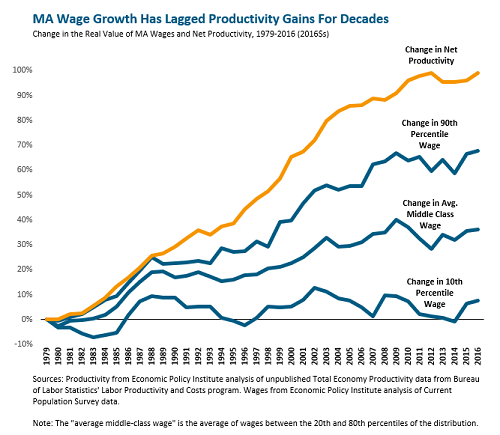
This graph [0] is way more relevant for the people in HN, and shows that for the top 10% growth hasn't stagnated, who I imagine overlap significantly with the people posting here.
1. Just because we're in the top 1% doesn't mean we shouldn't care about the bottom 99%.
2. That graph shows that (real) wages are basically flat for each group the last ten years of the graph while productivity has almost inexorably climbed, so I'm not sure I'd agree that it "hasn't stagnated".
>2. That graph shows that (real) wages are basically flat for each group the last ten years of the graph while productivity has almost inexorably climbed
Are we looking at the same graphs here? In the last 10 years of the graph, I see that both productivity gains and wages were leveling out.
It's a terrible graph (no gridlines!) but if you're willing to open it in an image editor and draw some lines, it becomes pretty clear that wage growth for the 90th percentile is up 5 percentage points over the 10-year period, while productivity growth looks to be more than twice that number.
Also, it's the long-term trend that matters. Is the gap between each blue line and the yellow line narrowing or widening since the start of the graph? It's the latter, so things are getting worse and not better.
Look at what people had to do in the 70s and 80s... You'd spend all your time doing math to fill out a spreadsheet, cutting and gluing construction paper to make a presentation, or re-typing a document to change a sentence. That's not the machine doing the work, it's just the machines making it easier for us to do the work. But the end result is an expectation to produce more better quality work faster than our parents or grandparents had to.
My grandparents had a summer house, they took 7-kid family vacations, and they disconnected from co-workers when they left the building... And that's what "upper middle class" in America used to look like 40 years ago. And they had unions, and pension plans. When my grandfather retired, his pension was 80% of his pay for life. Plus what he had saved up for retirement.
Technology has made us more productive. Here’s an example. We only have two people in AP because we have software that monitors our AP email address and ingests invoices and sends it to the appropriate people for approval. Back in the day, people would open physical mail, and send it through corporate “mail” system for physical signatures.
Those are the same thing, because operating the machines means you need new skills, and therefore should expect labor wages to rise.
For example, 15th-century peasant can't use a computer at the level of a teenager playing Minecraft. So clearly it's not just the machines; it's the people. And as the chart shows, the people are getting a raw deal.
Lately I feel like celebrity CEO & VCs (namely Elon Musk) are actively trolling workers. Emphasising that workers are inherently dead weight. I believe publicly stunt layoffs like Twitter have a far reaching negative impact on worker morale. Maybe in the short term you can use fear to squeeze out some overtime but ultimately I believe its creating dangerous worker/employer resentment.
I think the resentment was already there before. Plus, in my opinion, they did an excellent job framing the old Twitter team as lazy entitled social justice warriors, so I expect Trumps & Musks core target demographics to absolutely love those firings.
A big question is going to be: Does the `Trumps & Musks core target demographics` who enjoy this narrative actually contain the talent pool to pull from? I don't know.
Lol, of course not.Most people/workers just don't want the headache.
They just want to be able to do a job and be compensated well so that they can have a life to enjoy. VERY VERY few people want to work 80 hours a week at Twitter for a reduced salary and stock options that sit behind all other investors and the billion dollar albatross Musk put around the company's neck.
The skeleton crew at Twitter today are H1B's that literally can't leave because the tech world is burning around them... and that's sad.
Or they figured out that the work that they put in isn't doing anything for themselves, regardless of how much money they get.
> For Marx, the possibility that one may give up ownership of one's own labour – one's capacity to transform the world – is tantamount to being alienated from one's own nature and it is a spiritual loss.
This. The difference for my SO for crossing her arms for the entire year and doing nothing vs dying stressed with overtime and selling millions is an 8% bonus.
I live in a productive rural district with high exports; dumb people and million dollar machines don't produce anything of note.
People that know the ground, know the past variations, know their seed stock, etc. produce good returns over decadal periods, as yet machiness and AI alone don't match that.
I hope you're not suggesting that farming is easy and that you just need the right machines. Otherwise, your argument is that a 15th-century peasant possesses all the necessary skills, education, and training to operate a modern farm, and they just need the right equipment.
How would you determine if increased productivity is due to "labour or capital"? Are people themselves more productive, or are the machines just better?
Everywhere I have seen, machines are doing almost all work.
One could make an argument by comparing the effect on productivity by either replacing the worker or the machine. When workers are readily available (and machines are designed to make workers replaceable), it doesn't matter what a time-transplanted peasant would do.
The required skill level when using older tools and processes (welding and other building processes) is typically higher than with modern tools. This makes workers more replaceable today.
Modern tools make productivity less dependent on the skills of workers. It's not a moral argument, just a fact that explains the observed phenomenon.
Try using, and servicing, an old industrial lathe or anything else in a mechanical workshop and see how quickly you can get up to speed. Repeatedly achieving meaningful results, and keeping the workshop functional and clean, was someone's career. It is not "easy" and ideally requires a degree to understand materials and forces, and so on.
All these complaints that productivity growth has been matched by salary growth always seems to ignore that most of the productivity gains have been the result of capital expenditure, not of workers being better at their jobs.
The execs of each company didn't personally invent every machine and write every piece of software their employees are now using to be productive. Hell, a lot of it they didn't even particularly choose—so much of the productivity gains comes from basic stuff like "personal computers" and "Microsoft Office".
They are benefiting from the labour and expertise of others, and saying that means they deserve to get more money. Why? Why should those gains not be shared equally with the people who are actually doing the work?
One can argue that neither execs or workers deserve more, but worker's pay is mostly determined by supply and demand, while exec's pay is a governance issue that's the responsibility of the owners.
Oh, hey, look; I’m such a hipster I was avoiding promotions before it was cool. I’ve worked in the industry for nearly 25 years. I’ve pushed back against every attempt to promote me into lead or manager type roles. I’ll happily work as an individual contributor until I retire.
One of the things that did me in was working insane hours (like 80 hour weeks) to get a project done on time. It was completed on time. My thanks was a satisfactory on my yearly review. When I pushed back on my manager, he said sorry, I deserved it, but they were required to give a certain percentage satisfactory and he had had to give the exceptional review to someone else. That is when I learned that the whole system is rigged. That was about 15 years ago. I’ve been coasting ever since.
The ridiculous bell curve… I was also quite surprised early on my career. I was asked to rate my colleagues, when I said they were all top performers, as we had such a tight team (we could really depend on each other) and it was a very homogeneous group skill wise, my manager presented me “the bell curve”. I couldn’t really grasp it, context wise it made no sense.
I thought things were changing a bit: https://www.forbes.com/sites/joshbersin/2014/02/19/the-myth-...
My take on work is have fun (yes, I can do some extra hours now and then), never neglecting physical and mental health.
I think I'm headed in the same direction as you only 5 years in. In 2022 I pursued a Tech Lead role heavily and was rewarded with it. Then I got burned out from the immense effort to get there and the subsequent new onslaught of pressures and responsibilities. I quit the company about 6 months into the TL role after being forced to deliver a botched project to meet an arbitrary deadline.
I still don't think I've recovered from the experience - my team was pretty great and the tech was healthy, but the management surrounding all this really put me off redoing this for a long time, if ever.
I phrase it in this way: I can no longer deliver 100% of my "personal excellence" to my employer. I "selfishly" want a good chunk, ideally most of it, to myself for my own pursuit and life enjoyment.
Sorry to hear about your experience. Tech lead was very enjoyable for me for five years. I recommend you find a better company and make it clear that made-up timelines by project managers are just that. Adjusting expectations is much easier than working 80 hour weeks.
> When I pushed back on my manager, he said sorry, I deserved it, but they were required to give a certain percentage satisfactory and he had had to give the exceptional review to someone else.
In some organizations, the manager could've urgently worked up the chain of command, that some performance review plan had, er, unintended consequences. If that was the situation.
(The organization might've had a plan for raises that they could quickly reformulate to have the same cost but better morale and retention outcomes. Or this might've been their way to quietly prepare for layoffs, or to implement some awful stack-ranking practice. Or maybe a consultant, golfing buddy, or someone who wanted some change credited to themself... proposed some questionable HR practice. Or, if your manager wasn't being truthful, it could be that there was some reason that they or someone higher up thought/wanted you to get a lower rating, but manager didn't want to tell you that, so they blamed it on the curve.)
We have those. They are meaningless. I don’t believe for a second they are anonymous, and most managers don’t have many direct reports. They can figure out who is talking smack pretty easily. And, there are no upsides to being seen as a complainer/troublemaker. Better to just quit and move on if you get a bad manager.
This should be standard practice—not just managers, but also other people at all levels that they interact with on a regular basis. It's called a 360° review.
Upward feedback of executives can work, as I heard an executive rant about how the upward feedback program was a conspiracy against him by his peers, before he eventually vanished.
As others note, feedback that only goes up one level can't really be anonymous.
> A group of first-year analysts at Goldman Sachs Group Inc. complained to bank leaders last year that they were working an average of 95 hours a week and that job stress had harmed their physical and mental health.
I'm pro-ambition, pro-commitment-to-the-team/mission, and a recovering workaholic. But don't do crazy hours like this. It's permanent damage.
Target 40 hours a week. Make those hours productive towards the org's goals and not misaligned individual goals/metrics (experienced engineers and the manager and PM should be blasting the inefficiencies out of everyone's way). Keep stress low, and only for good reasons (again, stupid reasons need to be fixed promptly).
If you've got people being actually productive and on-track towards org goals at 40 hrs/wk with low stress, that's a great environment. And when some rare emergency happens that can't just mean slipping the schedule, then some people will have the time/energy/morale to surge their effort to to whatever sweat/magic is necessary. Then they get flex time after.
And we educate new people about how we were able to handle the emergency, and the importance of not breaking this hard-earned effective organization.
I agree and the following is more related to the text you quoted.
I interviewed at GS and as soon as I saw the room of clearly exhausted and joyless developers, I could see they actually valued the appearance of work more than productivity.
It is sad that 100 years after Ford made the discovery people still don't get this. Team A consistently working 40 hours per week will output more work than Team B working 60+ hours per week. That's true for 60, 80 and especially 95+ hours.
For me, doing 40 hours of actual work means staying 60h near the computer or in the office. I take too many breaks chatting with colleagues, or browsing HN. Well, this is my problem...
Plus my company measures "impact". Unfortunately, lot of work which has to be done is not impactful from management's perspective, and requires working more in order to generate impact and have something to say in your self-assessment. Of course, everybody in my team do work more than 40h, so you have to keep up in order not be in the 15% of low performers in line for the next layoff.
I report 40h. I might be 35h at my computer. That might be 20h of productive work. No one ever questioned my work output neither in quality or quantity.
The idea of the 40h work week isn't to be productive 40h, no one can do that in creative work. The idea is you are available 40h. If you are at a healthy workplace, then no one around you works more than 40h either.
40 hours of total work. Not 40h of your best work, 40h of output.
If that lands you in the bottom 15%, I’d start looking for other opportunities.
I’ve been in your shoes. We had time tracking and for me to consistently log 40h of actual work in a week, I’d have to sit in front of my computer from morning to night. Even weekends sometimes to catch up on what I’d missed.
What a fool I was.
I did that for years for mediocre pay (although I couldn’t see it at the time) to the detriment of everything else around me.
It wasn’t worth it. Now I couldn’t care less. The whole “quiet quitting” phenomenon resonates deeply with me.
This article was a really interesting read, because I've been thinking lately that companies tend to succeed off the back of people caring a lot and putting in extra hours but I haven't seen this verbalized before.
I think the young guy they interviewed whose dad makes barely more than he will summed it up perfectly. You realize that if you put in all that extra work you get paid fuck all extra. It doesn't make any sense to work so hard for so little reward in most fields.
I feel like tech, finance and maybe law are the only corporate careers where it makes sense to work really hard because there are outsized rewards for high competence, but even then it doesn't always make sense.
Millenials kind of realized this Zoomers have fully realized this. Probably related to most fields stagnating heavily career-wise and having relatively poor pay.
It's interesting to see a lot of Millenials and Zoomers cottoning onto the fact that tech pays well. It's surprisingly common on social media and IRL to see something along the lines of "someone is making a lot of money = most likely works in tech", and vice versa.
Millennials are the first generation to see the full impact of the brainless and soulless policies enacted by the US government in 40 years. They understand that what the government says are complete lies that are making people poor and destroying their livelihood.
> I think the young guy they interviewed whose dad makes barely more than he will summed it up perfectly.
actually i found that to be the most flawed part. they didn’t describe the industry the dad was in, nor the dad’s wage when he had the son’s YOE. it’s fair to report the feelings of the son to the revelation, but intellectually dishonest to leave out some basic objective analysis around it.
that said, flaws or not, yes it seems that is the crux of it. people are done with working to improve the lot of the masters. something i think would help is to reduce CEO to median worker compensation multiple.
Any field where you can own/buy the means of production it makes sense to grind out skill early career and go off on your own. Otherwise just optimize for lowest effort
I've noticed an absolutely fantastic increase in the number of my employees who just refuse to work beyond 40 hours without compensation. Many refuse to do it even with compensation.
It used to be I had like 1 dev who was that way. He come in at 10. He left at 6. Period. Any "overtime" was an immediate PTO accrual, without exemption. He'd work a Saturday, but he was taking off Monday.
The rest of the team worked whatever was required of them.
It created a lot perverse incentives for me, my co-owner, and our clients. If we kept hitting impossible deadlines, why wouldn't our clients keep asking it of us? Why wouldn't we keep saying yes to them? It made fiscal sense to do so. Clients were happy. We made more money. Staff largely didn't complain.
Now, the "workaholics" are a lot more rare, and we're a lot more careful about it.
If someone works over 40 hours, we compensate for that, salaried or not. It's called overtime, and we actually take a lower-margin on the hourly rate. If we're making our team work more than 40 hours, we fucked up. We deserve to make less money. We also charge a "rush rate" to clients, because while we're happy to help them out, the team deserves to be compensated. We've only had one client push back on it, and we fired them.
The staff is a lot happier, our clients have adjusted to the new expectations, and our staff churn has lowered.
Too many people have been burnt by this before. All the reward goes to the boss and not the employees. I used to work 70+ hours and I didn't even get a thank you. I will only work those hours nowadays if I am working for myself. If not, there is no chance I will do it. It's not nice to know you are being used for someone else's personal gain.
I have seen people pull crazy hours and then suddenly fired for performance reasons. It makes you look at the employee / employer relationship as a transaction. And within this transaction the boundaries are clearly defined.
This job can be fulfilling and interesting, but unfortunately we are being squeezed to produce maximum orange juice. Companies dream of reaching and maintaining high growth rates and valuations.
We should shift to valuing consistency over raw velocity. Long-term, I think this is the winning strategy.
You don't need to be rich for that. Even if you're struggling financially, going out to tech events where you could meet potential partners vs. sitting at home with your head down could be the difference between "getting lucky" and spending the rest of your life in a W2 situation.
Business is about connections and rich people get a great head start on the rest of us, but the average person does a lot of self-sabotage, as well.
If you were lucky to make your fortunes, of course, you’d feel more comfortable if you think that _you_ did and not a roll of a dice.
I did well for myself comparing to what I came from. I could probably do better. But at some point, I laid out how it all played out. The kicks that made me serious money were simply luck. By working and exposing yourself, you increase your luck surface. But that doesn’t change the fact: It’s luck.
Now, if we are in a hot field like Tech, many more people are going to make it. That’s not because Tech people are amazing, but it’s because Tech is booming. Luck here starts to make sense only at the extremes (ie: becoming a Zuckerburg) but at a local area, because luck is abundant, your hard work matters more. We are all lucky (Tech people) to be in this very particular time.
Your fairy tales ignores all the people that tried correctly to build the their luck and yet ended in a worse situation by pursuing success based on incorrect world view.
I’ve watched this argument play out many times here, and I can see you’re dedicated to winning it. Have a quick think about what will gain by successfully convincing the person trying to help you that success is impossible.
Personally I’m really happy that I gave up making excuses and actually tried to improve my situation. Despite all your persuasive arguments and conviction that it’s all a pretty fantasy, it did in fact work.
Here’s hoping we get to see you arguing the other side one day.
Their point isn't that success is impossible. It's that "If you work hard you will succeed." is a fairy tale and that it's irresponsible to assert otherwise.
That's something for the other poster then. It seems you both are talking past each other. I'm not trying to support one argument or the other, just clarifying to improve the discussion.
I’m at 2 for about 15 now, in terms of profitable SaaS businesses to good, several month attempts. It took maybe six or eight tries to get the first one going, so I’d say I’m getting better with practice.
I don't state that success is impossible. I just don't care, my only argument is to entice people act on well informed situation, properly evaluate their luck or chances of improving it.
This is the real and _only_ way to improve their chance of success, just telling that «you have to create your luck» or other non-sense, is just dangerous advice that exists only based on survivor bias and does nothing but improving the risk of destroying lives.
I wish. But my attitudes have been formed by my life experience, that of my friends and acquaintances, and my reading of history books.
A common thread is if you believe you cannot succeed, you won't. If you blame your failures on others, fate, etc., you will not succeed. If you find yourself saying "it's not my fault" a lot, your life isn't going to go well.
On the other hand, if you accept full responsibility for your failures, and do your best to learn from them, and are willing to try again, then success becomes probable.
I know these views are very much out of fashion today. But they still will work for you, if you choose to implement them.
Let me shoot that statement down in flames for you!
Successful businessmen have a lot of initial funds to pursue a lot of different ventures of which perhaps 1 will be a success.
If you ever talked to the successful businessman types you will find they have lots of companies but only 1 will be the source of their money. The rest either lose money or break even.
I'm just telling you the pure mathematical truth of the situation.
According to the maths, given people of identical skill and the same starting funds. Some small percentage of people will get lucky and accelerate out into riches whilst the rest will drop into poverty.
The people who accelerated into riches can't tell you why they accelerated out into riches, since it was purely luck based to begin with.
The more funds you acquire, the more risks you can take, the more money you can make.
Taking risks doesn't make you rich, becoming rich makes you take risks. It's that way around.
I think it's probably better said that they "prepare to capitalize on luck." Most people don't do that, because it is fairly costly to do, but it pays off when you eventually get lucky.
I did start my own business! Man I’m worth much more than in companies, plus I’m having fun creating software, and I now understand all the incentives around my work instead of having to play politics, which, as a computer guy, is much more comfortable.
HOWEVER, many who have tried to launch products have not met success. But I was happy to try and fail too.
I did start my own business, 8 years later I earn 2x what I was paid (not FAANG level by any means mind you), work perhaps 3x less, the work is a lot more enjoyable. I was a SE.
You need to provision enough time (years) to hit market-fit, and plan for errors being made along the way.
Large chance element. There are reasons why VCs invest in 50 startups with the expectations that one will succeed. You probably need to spam business ideas and see if you can find one that gains traction.
Yes, it's risky running your own business. But if you want to make it big, it's the best route. More risk, more reward. If you want to play it safe and have someone else take the risk, be an employee. But safe means less return.
I've known way too many lawyers, doctors, tech bros, and finance bros to believe in these silly platitudes.
It might have once been the case that reward correlated closely to risk, but the economy has fundamentally changed faster than our attitudes.
We believe that the US is still the meritocracy it was when we were young, but loads of economic studies show the US has steadily declined in this regard. More than ever, money circulates among the well-connected and wealthy.
The real secret to getting rich today is to be born rich.
The system doesn't have to be completely fair for it to work. Of course being born rich means you are likely going to be rich. However, if you're trying to climb the ladder, the advice you reject as a platitude is fundamentally true. Being an employee you're accepting a limited compensation and getting certain benefits in return, including safety. If you have marketable skills, nothing stops you from building up a business to sell these skills directly, at greater risk but also increased compensation if it succeeds. This is true for an enormous variety of fields, but especially tech.
If you claim that, how about your own comment? And with
> nothing stops you from building up a business to sell these skills directly
you pretty much completely ignore what OP wrote. Sure, you can claim "technically correct" because indeed nobody is stopping you. You just leave out the statistics about the result. What is stopping people is looking at their actual chances, so sure, you can technically claim they are stopping themselves. Only that it's highly misleading.
I left awell-paid software job in the US and returned to Germany, opened a small business with a friend after looking around. We barely managed to sell it off at cost, leaving the next person to find out it really did not work (he saw everything but thought he could do better). Then I did freelance jobs, very highly paid. Also extremely unsatisfying. The especially well-paying corporate jobs especially so, more often than not what I had worked on was discarded after I left, because of company merger or internal politics leading to a stop on the project.
Now I'm in a business started by a former CTO of a famous successful startup, where he made lots of excellent connections and also has the brand name recognition now. I only do tech now. And no, you can't just easily connect to the right people. Some few one-in-ten-thousand people can do that. Most people have the necessary connections through birth or from previous employment. Creating them from scratch is incredibly hard.
When giving general advice about something and not to somebody specific for a specific situation, I suggest to
always scale your advice, from "works for anyone" to "works for everyone". Many of those suggestion fall apart right then and there.
How about if we already are in a situation where everybody does their very best? It's just that the equilibrium created from that is what we have now. Because the system does not work when "everybody" does it. You get a dynamic equilibrium with lots of losers and a lot of effort just not being worth it. Despite starting out with everybody highly motivated and adventurous. So "try harder" IMO has already happened long ago and we now are in a much later state of the dynamic system. What happens in the "everybody works hard" phase is a lot of pain and the winnings going to a few winners who sit at key points in the network.
You mentioned statistics and provided anecdotes. Also, ironically, you perfectly exemplified the risk/benefit trade-off: you took some risk with the idea that you could make more profit, but ultimately that failed - which is why being an employee is sometimes a good deal for those who would rather have peace of mind. Your example of your current boss, who both founded and worked for another successful startup, is precisely the other side of the coin here.
Let's look at statistics then. In the US, it seems that about 30% small businesses are successful enough to last over 10 years [1]. Your personal failure in one particular venture is not out of the norm, but your rant against entrepreneurship is totally wrong.
By the way I don't think anyone is arguing that the system is fair, that people who don't start businesses are lazy, or that everybody can make it. I don't know where you came up with these arguments. All that has been argued is that trying to start a business on your own is a risk/reward trade-off strategy that can pay off, and often does.
And “successful enough to last ten years” says nothing about whether they actually make more than median wage in the US or how much capital they put in to start their business.
Most “independent business owners” who own franchised locations for instance have owners who work 50-60+ hours a week, and have spouses and their children providing free labor.
If you look at the net income of most franchise locations, they average around $60-$70K berz
The question is not whether they make more than median wage actually, if you want to nitpick. It's whether they make more than they would as an employee. Yes you need capital and that's part of the risk. Also reducing the argument to be about "franchise owners" is a strawman.
Is it really a “success” as a business owner to make less than the median wage and have to put capital at risk? No serious investor would settle for less than average return and not have a risk premium.
If you work at a bakery and earn minimum wage but somehow save enough to open your own shop, the fact you may now earn less than median wage is not relevant. Do you understand now or would you like me to draw you a picture?
How much does it cost to start a bakery? What would be the future risk adjusted cash flows of opening a bakery compared to just putting the money in risk free inflation adjusted bonds? What’s the relative risk of putting the money in an index fund?
And no I’m not just throwing out financial terms. I’m a proud MBA dropout (undergrad in CS)
How would that have turned out if you invested that money in your own store and opened it in February 2020? What happens if you open your store next to a store like Walmart or in a mall next to one of the major chains and they closed or moved reducing foot traffic (saw that plenty of times)?
If you can save up enough money to open a store, you can also save up enough money to go to technical school and learn a trade that is a lot less risky.
If you are a CS major, can successful “grind leetCode” and get an offer at any of the major tech companies, you can get an offer in the mid $100s minimum. In five to seven years you can get $350K+.
Realistically, what are the chances of your own business having that income trajectory?
The article was not about only tech, and the parent mentioned many other fields as well. I also don't think your imagined career path reflects the reality of even 0.1% of tech workers in the world today.
Not everyone is a polymath like you. Some people are best at a company because they either can’t handle the business end or handle the people management or possibly the technical end. You have to be good at all 3 to make it. Or just lots of luck
> more risk, more reward... Be safe means less return. You can't have both safe and lucrative.
Taking a bigger risk could result in a bigger reward or also result in a bigger failure. Be safe doesn't necessarily mean less return, it means less return only if your risky bet pays off, if your risky bet fails you are likely better off yo have played it safe instead. Not sure what that has to do with what one is "really" worth as you put it.
Yeah, it does. You can see it in stocks & bonds every day. More risk means more potential upside. Less risk means less upside. Across all the investments.
You pay more for a new car because it comes with less risk. You pay less for a used car because it might be a clunker.
What do you consider “lucrative”? Even when you hear anecdotes on HN after accounting for survivorship bias about posters who have their small “lifestyle business” rarely do they talk about netting in the mid $150s - the amount that a fresh college grad can get by “grinding LeetCode and working for a FAANG” (tm r/cscareerquestions) let alone the amount that you can get as a senior dev at the same question.
Let’s talk about “consulting” and what the word actually means.
First you have people who call themselves “consultants”. But they are really just staff augmentation. Those “consultants” are a dime a dozen and all in, can’t command a premium and would probably be better off working a full time job.
You can find some just as good overseas and a lot cheaper.
Then you have your actual strategic consultants who have “a seat at the table” and talk with people who control budgets. They can charge a premium.
After working with both as a tech lead between 2016-2018 is what made me pivot to getting experience in “cloud” and specialize in “application modernization” - enterprise dev + cloud + “DevOps”.
You have to both have a network and find companies willing to do C2C contracts. Those are also some of the first people to cut during a downturn. You saw that a lot right after Covid.
I now work in the cloud consulting department at AWS. It’s a full time position and my compensation structure is like SDEs.
I would hate to be constantly hustling for clients and take care of all of the other minutiae that I have an entire organization to handle.
I agree with everything except the staff Aug part. Anecdotal I know but I myself found a subcontract(!) as my first solo gig that easily beat my previous fulltime jobs pay, which weren’t peanuts either. And this was just Rails web dev.
My impression is that you can pretty easily beat fulltime pay doing fulltime staff aug, except faang salaries. Of course it helps if you have a spouse with health insurance.
Unlike a lot of posters in tech on HN, I have experience with both the enterprise dev side of the world where most developers work and FAANG compensation.
I’ve worked a lot longer as a developer. But because of bad career decisions until 2008, I ended up doing a career reset.
My first experience with staff augmentation type contracting was in 2011-2012. The company I worked for went out of business and was sold for scraps and I got a contract working with one of our customers.
Local tech salaries for my skillset were in the low $100s - standard mid level C# developer. I couldn’t push above $60/hour. At 1800 hours a year, it was a wash. But no health insurance - I was also married.
The next time was in 2016. I purposefully took a contract to perm job to get my first tech lead experience. I couldn’t find contract jobs for more than $70/hour. That translates to about $126K which was a little below average for senior dev in my area ($135K - $150K). But a racked up on hours.
When I was hired full time, we were paying the contracting agency $90/hour and the contractors were making $70.
Perhaps there’s something at play where for more “common” languages like C# and Java, there’s more competition hence lower rates, whereas something more niche like Rails can command higher rates even if the total number of opportunities are fewer?
Is it? How much deadweight does a company have to carry: Testers, PMs, consultants, CxO jets, they’re all useful but how much? How much money would you make if you could deliver a service while not putting 70% of the profit feeding the fruitflies?
Statistically, you have much more chances of making money if you don’t have deadweight in your company.
I’m making about 6x as a software founder as what I used to earn in a company.
Startup employees take the same amount of risk by giving up salary for equity. From a strictly odds perspective, most early stage startup employees are better off working a corporate job and pocketing and investing the delta in cash comp.
Owner takes no risk. With they are already rich so losing the business doesn't matter, or they are operating an LLC on a loan that discharges in bankruptcy.
Not usually. Llc is a bad tax structure so successful businesses don’t often use it. Also if you ever take a business loan you are personally on the hook for the whole thing. Personal guarantees are the worst and you can’t really get out of them
> All the reward goes to the boss and not the employees.
Make a mistake though and bosses are quick to point the finger directly at you. Credit and rewards for the higher ups, blame and discipline for the rank and file. Privatized gains, socialized losses.
The funny thing is, I work in finance and see these decisions up close.
The owners explaining their decisons to me while keeping a straight face.
Make no mistake, owners (no matter how progressive, with very few exceptions) will screw you over if it improves the bottom line or their remuneration.
It's one of the worst aspects of my role. Owners straight up lying to my face about why they do things.
I will (and have) happily worked 80 hours per week, if you compensate me.
Instead, my real wage has decreased this year. Of course, this means I substitute free time for work. My work time budget has been reduced.
Since real wages have been falling consistently for most workers (US Swe excepted maybe) this should not be surprising.
Profits are up, real wages and wealth share of younger workers decrease. Who is to say which causal direction this has with work time?
Back in the day, sinking in all that free time paid off. Now it pays off less.
For me, it has nothing to do with ambition.
Sad to see that many decision makers are apparently wrong on this.
Most CV's I come across now average 18 month stints before a bump in level and change in company.
That is not them being untrustworthy, it's signalling that they will move if they are not recognised for their work and growth.
Generally it takes 3-6 months to get productive at a new role, another 6 months to generally show competency / growth, and the last 6 months is spent waiting for recognition that you are willing to move up.
Unfortunately the most common growth structures dictate that people need to "act" as if they're in a more senior role already, alongside doing their existing one, and maybe they might get the title and salary bump. Often they don't, or are promised at their next review. Most just move.
If there's a group of 3-6 month (or shorter) spots, then I'm certainly asking about the work that happened during those.
> Unfortunately the most common growth structures dictate that people need to "act" as if they're in a more senior role already, alongside doing their existing one, and maybe they might get the title and salary bump.
This policy was explicit at my first corporate job, and it was a major contributor to my decision to work for myself.
Imagine a system where an employee is identified as a candidate for a higher position and tentatively promoted to it to see if they can adjust to the role. Sadly it seems the only place this system exists is the role of startup founder.
Something that’s missed in this analysis is that there have to be two elements in place for a promotion. As you’ve identified the person looking to move up needs to be ready for it (I’m fully with you on it being BS to expect them to be doing the job already).
On the other side there needs to be a position for them to move into - there isn’t an infinite number of Senior/Lead Developer jobs available in any given company, and typically the ones available are already filled. You’ll have a better chance at a large company where there are other teams you can transfer to, but then you’re dealing with the increased bureaucracy around that.
Elon Musk's real wage decreased $200B this year. Regression to the mean hits all of us. You were being paid in funny money. The real economy post-Covid is much smaller than it was before Covid, unless masks and test kits and vaccines give you as much utility as food and cars and video games.
In the days when I was overworking, I had an office with a door and windows, rare (sub-weekly) meetings, and in-the-money options. Why should anyone in an open plan, with substantial coordination/micromanagement overhead, but without significant equity do the same?
As someone in the article explains, she was happy working hard (and getting pay rises) until she spent time on TikTok, which quickly convicted her to work less hours and demand higher pay.
TikTok, a Chinese app, is not allowed to show you such content in China and must instead show pro-work, pro-family messaging.
So what you're saying is TikTok is a psychological operation designed to weaken the economy of western nations? Honestly I wouldn't even be surprised if that was the case.
Doesn't invalidate the "less for more" philosophy though. This is what everybody should strive for. The chinese will too, in time.
>over organic content created by TikTok users about workers‘ rights?
the algorithm can be easily influenced to push propaganda and sway opinions. From the Twitter Files (and even prior) we know the old Twitter regime, for example, existed to push woke leftists agendas, including working with the whitehouse and various govt agencies to push propaganda.
TikTok videos aren’t pushing for fair pay or working conditions. Those videos will have low engagement and view through rates, being dry and boring topics.
The psyop is about making consumers aspire to be a social media influencer, rather than having meaningful role in society. The videos pushing for fair pay is often “sign up to get my get rich quick course”.
China’s version of Tiktok have forced content filters and the content featured by the algo is radically different from the US version. They’re winning the psyop.
That’s not what the Twitter Files showed at all (even assuming a generous meaning of “woke leftists agenda”). In fact, what the Twitter Files showed was the one occasion that they did push the White House’s position, it was done by a low level decision maker and was overturned very rapidly once it became known by management, and led to changes which greatly reduced the chances of something like that happening again.
Completely false, and this is bogus narrative that the mainstream press is pushing in their efforts to coverup how much influence govt had over Twitter. US govt is heavily involved with pushing propaganda across all outlets, but only Elon has opted to expose it to the public, making him a threat to the establishment, especially the woke leftists in power.
> 14. This secret group included Head of Legal, Policy, and Trust (Vijaya Gadde), the Global Head of Trust & Safety (Yoel Roth), subsequent CEOs Jack Dorsey and Parag Agrawal, and others.
> 15. This is where the biggest, most politically sensitive decisions got made. “Think high follower account, controversial,” another Twitter employee told us. For these “there would be no ticket or anything.”
Twitter management was fully engaged. The head of trust and legal were involved in decisions, especially the ongoing partnership with the FBI — with screenshots and transcripts showing the deep levels of engagement. If you’ve not seen this, you must be reading about twitter files from a 3rd party or ignoring what happened.
> The Aspen Institute hosted reporters, media companies and social media firms in Sept. 2020 to prep for a possible Russian hack of Hunter Biden, one month before the NY Post story, at a time when the FBI had the laptop and had Giuliani under surveillance. Amazing coincidence.
> From the Twitter Files (and even prior) we know the old Twitter regime, for example, existed to push woke leftists agendas, including working with the whitehouse and various govt agencies to push propaganda.
They didn’t reveal anything like what you describe. And the admin in the White House when the supposed collusion happened was the Trump admin.
It can be both. There are many honest and ardent people on TikTok motivated by labor rights. If I worked for the CCP, I would boost that sort of thing as strongly as I could.
Nonsense, the same information can be found in Facebook, Twitter, and other social networks. If that is the case, then American social networks are working secretly for foreign countries against the US. Is that what you believe?
I think the problem is ultimately an American one, and without tiktok Americans would find a different online venue to crowd-source these memes and persuade each other. Ressentiment will out.
Culture war topics will naturally get optimized by these algorithms due to engagement etc.
Thus the removal of content restrictions alone would be enough to push these to the top, so this alone is not interesting.
I'd imagine the CCP would find the discontent these videos sow to be convenient, but despite that perhaps it would result in net positive if workers wages rise and wealth inequality gap falls.
Tbh I'm more concerned about the algorithm promoting vapid entertainment dumbing down the next generation while apparently in China educational videos are more promoted.
In capitalism, every agent should at all times be looking to make the most money with the least input.
That way the most urgent tasks tend to get handled first.
This goes for corporations selling higher margin things to easier customers; customers seeking higher quality and better service for less, and workers seeking higher pay per time and effort spent
I was fired a few months ago from a well paying swe job; they said my performance was lacking because I was only doing my job and not more. Because the company is actually on my linkedin (they insisted on that to have my name there), my potential replacements contact me. I tell them it is nice work with quite a bit of responsibility over the technical side of their products, but they hire people (and this was true for all my colleagues) that will go the extra mile without the extra compensation. They don’t give out shares or bonuses so it’s literally without benefit. I took the position because it seemed like it was exactly that; pay for a 40 hour week, no shares, inflation indexed raise yearly and that’s it, so there is no reason to work more or over 40 hours. This expectation is pretty weird.
“I spent the first 15 years of my career climbing that ladder, being ambitious,” he says. “I don’t want this to be what’s written on my tombstone. And I certainly don’t want the stress to be what puts me in a grave.”
100 years from now historians of labor will mark the COVID-19 pandemic as the time of the great reset, when labor finally got fed up with
-- Being constantly told to "do more with less" after yet another round of cost-cutting
-- Being loyal to companies that weren't loyal to them
-- Being exploited for some vague promise of reward in the future
-- Having no social or family life
I'm glad this has finally happened; I'm just sorry it took a global pandemic to force the issue.
The WSJ, being the WSJ, phrases this as though long weekend nights chained to a desk should be the expectation, but in a wider sense, we're living through a good old fashioned race-to-the-bottom. The US has an unhealthy society where nobody believes in what they're doing, and we're not very far from the "We pretend to work, and they pretend to pay us" disease that we scoffed at in the Soviet Union.
> "We pretend to work, and they pretend to pay us" disease that we scoffed at in the Soviet Union
That was after the arms race that Kennedy started to starve the USSR out of GDP succeeded, when the USSR was allocating all its GDP to defense instead of consumer industries. Which immediately stifled the extremely impactful consumer industry that the USSR had from 1950s to late 1960s. In that period, Kennedy admn. was quite concerned about the progress of the USSR, circulating internal memos saying how the USSR was able to raise the life standards of its people from desperation to 2nd world standards within the same generation, and at that rate other countries could start copying their development model. Ie, socialism. If this was not countered, the global economic control of the US that it gained in post-Ww2 environment would fell down like dominoes as nation after nation chose socialism and allied with the USSR. This was later called 'the Domino theory'. To prevent it, it was decided to 'make examples of' the countries that tried such 'independent development' (that's what they call socialism in their internal memos). That's where the Vietnam War originated from. Also all the other things including the blockade on Cuba etc.
What relevance this has to the topic at hand is that, if the employees feel that they are actually receiving something out of the work they do and their lives are getting bettered in ANY way, they work. If there is no improvement regardless of how much they work, they just dont care anymore. That's the current situation in the US - any wage raise is immediately sucked out by the privatized critical services ranging from healthcare to food, from rent to education. Its just not worth putting in more effort anymore because the more effort you put into making money, the more the market sucks out of your wallet.
> That was after the arms race that Kennedy started
The nuclear arms race started immediately after WWII (or possibly during it), the space race (and associated missile race) started in the 1950s. The idea that Kennedy started “the arms race” is…ahistorical.
> The nuclear arms race started immediately after WWII (or possibly during it), the space race (and associated missile race) started in the 1950s.
Those weren't races. The decision to start an arms race and space race to starve the USSR of GDP is an explicitly laid out plan in Kennedy admn.'s internal memos.
The nuclear arms race, space race, and missile race (the second being intimately connected to the third, and in a way its public face, at least initially) were, in fact, races (and components of the broader arms race) and they, in fact, started before Kennedy was in office (the space and missile races, under Eisenhower.)
That Kennedy capitalized on that reality, and built a strategy beyond the most obvious superficial goal of those races, is clear, but to say that he “started” the Cold War arms race is silly and ahistorical.
> The nuclear arms race, space race, and missile race (the second being intimately connected to the third, and in a way its public face, at least initially) were, in fact, races
That's your interpretation. And possibly a likely noticeable segment of the public. The Kennedy administration's race is an actual, specific race with a specific plan. It cannot be 'interpreted away' like that. It was a specific decision taken with specific goals in mind. And those goals were not just 'reaching space' or 'have more nuclear bombs' like the others.
I recommend watching some relevant Chomsky lectures on the matter. He gives excruciating details of the affair.
> The Kennedy administration’s race is an actual, specific race with a specific plan.
The Kennedy strategy only makes sense as an a strategy within the well-documented arms race that was already occurring.
> It was a specific decision taken with specific goals in mind.
An arms race is not defined by the existence of a strategy of one side, it is an escalating cycle of response between two (or more) sides. The Kennedy strategy might help explain why the superpowers didn’t break out of the race sooner (though, really, arms races continuing until either one or both sides reach economic exhaustion or a geopolitical realignment through either war between them or intervention of a third power renders the race moot is fairly normal, so it’s plausible that the adoption of an obvious strategy by the more economically powerful power given an existing arms race did nothing.)
> I recommend watching some relevant Chomsky lectures on the matter.
There are things Chomsky might be able to convince me of, but effects preceding their causes isn’t among them.
> There are things Chomsky might be able to convince me of, but effects preceding their causes isn’t among them.
Sorry. Kennedy administration says otherwise in their internal memos released to the public via FOIA requests. This may not fit the worldview that you constructed in your head, but reality is what it is. In between what the Kennedy admn. itself says and your 'interpretations', I'll go with the former. Thanks.
Perhaps you could square your claim of Kennedy starting a space race with Sputnik 1 being launched (with an intentional radio transmitter) 37 months before Kennedy was even elected?
It’s funny, 15 years ago I made 30 percent of what I make today and I could afford a home in the same area I’m in today, but today I would need to make about 1.5x more to afford a home here. Capitalism isn’t “free markets”, it’s “the power goes to the people with capital” and that’s only the top one percent of one percent, for the most part.
> but today I would need to make about 1.5x more to afford a home here.
but there's no reason why you'd expect that the price of anything would stay at the exact same ratio it was 30 yrs ago.
The increase in prices of real estate is demand and supply driven, which implies that way more people got way more richer than you in the intrim 15 yrs. And not to mention some bad gov't policies that prevented an increase in supply, while demand increased, and you see high prices.
> but there's no reason why you'd expect that the price of anything would stay at the exact same ratio it was 30 yrs ago.
I am specifically saying that homes in my area, and most others, have risen in price at a MUCH faster rate than incomes. My example was meant to describe that situation, not just "standard inflation".
The government has interfered extensively in the housing market, this causes prices to go up. The same for the education and health care operations.
In the software business, which government has so far not interfered with, prices have declined to zero (literally) with lots and lots of revolutionary software being developed.
> In the software business, which government has so far not interfered with, prices have declined to zero (literally) with lots and lots of revolutionary software being developed.
Famously, software doesn't take any more resources to build and share than a few electrons and a laptop, so not quite the same market as homes which require a massive amount of resources to build.
I would argue that prices are not zero, they're just not paid in dollars. Ad-supported software is effectively a barter economy where the consumer does not know the true value of what they're trading away.
Um, no. The Vietnam War absolutely did not start because South Vietnam chose socialism, nor even because North Vietnam did. It started because North Vietnam invaded South Vietnam.
Before this situation started there was no South or North Vietnam, just one country. To say they invaded their own country is nonsense. The US invaded Vietnam, that is a better way to put it.
It was one country. They it was a country controlled by China for a thousand years. They it was one country. Then it was a country controlled by France. Then it was a country controlled by Japan. Then the Japanese lost WWII, and France re-took control of the south, and communist revolutionaries took control of the north. And then it was two countries, not one.
And if you're going to say that it was just one country, why do you say that it was North Vietnam that was that one country? Why not South Vietnam? (And if you're going to say that they were both that one country, yeah, come live in reality for a while, it's not that bad here. They were two separate countries for thirty years, in the same way that North and South Korea are two separate countries, and in the way that Russia and Ukraine are two separate countries.)
And as for calling it an invasion... there was sure a lot of shooting for it to have been a political convention.
Pretty sure, yes. What companies are "not allowed to fail"? Boeing? Maybe some big banks? Maybe Oracle, Microsoft, Apple, Intel? All right, what fraction of GDP are they?
All major airlines. Food production (farming + processors + distribution). Banking. Rail distribution. If any of these encountered existential threats, I have no doubts that the government would step in citing (reasonable) national security concerns.
Subsidy is not the same as state control. The PLA straight up owns companies. In Russia, the government directly operates over 80% of railway capacity. The fact that the US government is one of the primary customers of, say, Lockheed Martin does not make it a state owned company in the same vein s the above. It's still got public stock, an elected board, and otherwise operates like any other enterprise.
I would guess that mostly applies to small-scale farms and not the industrialized ones. OP is probably referring to the massive agriculture subsidies given out by the federal government to prop up the industry.
I remember reading comments here previously about how bankruptcy is frequent and almost a normal part of business for the farms that prop up corporate agriculture. I got the impression it was more of an accounting trick, like Facebook being Irish, and not an indication that the industry itself is unprofitable. Are the bankruptcies you're referring to leaving people in poverty? Can you speak to what portion of them are just failures on paper, as opposed to "real" failures that lead to halted operations and force people out of farming altogether?
You mean the bailouts which earned the government handsome profits?
> In total, U.S. government economic bailouts related to the global financial crisis had federal outflows (expenditures, loans, and investments) of $633.6 billion and inflows (funds returned to the Treasury as interest, dividends, fees, or stock warrant repurchases) of $754.8 billion, for a net profit of $121 billion.[89]
And the outflows include about 30% that went to Fannie and Freddie, which were quasi govt operations, and 10% to auto makers that the govt created no mechanism to recover money from.
In reality, outside of the original Bear Sterns collapse, what the 2008 financial sector basically saw was a loss of confidence which was leading to a bank run. All the govt did was provided a backstop that prevented the bank run, which is why even though the government took ludicrously low ownership stakes for the money they put in, their stakes were still highly profitable.
Another example showing this, but from the private sector, was Warren Buffett getting Goldman Sachs to basically pay him hundreds of millions of dollars just to lend his credibility, which was sufficient for them to weather the environment (this was structured as a loan, but the loan was just window dressing for the fact that Buffett was saying he had trust in GS).
In reality, there was always gonna be a recession as house prices went back to more realistic levels and the wrongly rated AAA mortgage backed securities were marked to market to a much more realistic number, along with the knock on effects on various portfolios that included them.
What tipped this recession into a major financial crisis was Paulson forcing Lehman brothers to collapse despite bids from at least 2 other companies that would have saved Lehman, simply because of a personal vendetta.
The overnight and unexpected Lehman bankruptcy sowed massive uncertainty into the markets, drove a bank run, and triggered a chain reaction of failed assets that eventually made it to AIG, and the risk of an AIG failure, was what eventually caused the crisis.
Much of it could have been avoided simply if Paulson wasn’t such an asshole.
> What tipped this recession into a major financial crisis was Paulson forcing Lehman brothers to collapse despite bids from at least 2 other companies that would have saved Lehman, simply because of a personal vendetta.
I would find it absolutely hilarious if Apple banning certain kinds of in-app tracking combined with Binance sparking a run on FTX for laughs ended up collapsing the software and crypto industries for a few years.
State support of specific corporations extends beyond QE (bailouts). The entire money-creation apparatus favors large corporations due to cantillon effects. In high interest environment, corporations can collect interest on deposits at the Fed (newly created money). during low interest environment, they benefit from people taking out loans (also newly created money) to push up their stock prices.
This does not mean the corporations are state owned. If all large corporations benefit from the "money-creation apparatus" as you say, they still have to compete and can fail. The US government did not dictate that Google, Meta, Amazon or Apple would overtake IBM.
Corporations may be on a somewhat level playing field with each other but they are given an unfair advantage relative to every other business (especially small business). Any help from the money printers can radically alter outcomes. If a large corporations is getting enough help to allow them to cut their profit margins by even 10%, that may be enough to put all their competitors out of business. Survival is often a matter of tiny differences.
Although big corporations are not state owned, they are subsidized by government/reserve bank money printing. It makes no difference if the enterprises are 'state owned' or 'state backed'. Ultimately, the providers are selected by the state, not by consumers.
I think the more relevant part is that people have realized that harder work does not necessarily pay better or lead to advancement. Companies can win markets while not paying their employees top dollar, and this fact is now clear to most if not all.
> Increased productivity does not necessarily lead to better pay or advancement
In a free market, supply&demand set employee compensation at about 85% of the value the employee produces.
The reason is simple. If the company overpays, the company goes bust. If the company underpays, his competitor will hire the person away.
If you believe you're underpaid, make your case to your employer. If he agrees, good for you. If he doesn't, and you're not convinced, quit and work for his competitor.
Unless your industry is a monopoly because one company ate all the others and is actively sabotaging new competitors by buying them off before they can grow.
US big companies are all backed by the government in one way or another. Friendly taxation, incentives, technology transfer, government contracts, tariffs on foreign companies. There is just a veneer of separation between government and private sector.
The funny thing is that inflation has been rampant for decades. However, this inflation only manifested itself in stock prices and other financial assets, and for this reason it was seen as great news. Now the inflation is migrating first to house prices, then to commodities and every other aspect of our lives, and they start to complain!
Companies answer to their shareholders first, their customers second, and their employee's third. When they give a shit, it's in that order. They reap what we sow.
No, they're beholden to their corporate charter and board. Shareholders who own voting stock can usually vote on who sits on the board. The shareholder and stock price primacy myth is just that, a myth.
Stock price is a part of a public companies responsibilities, but there are many other priorities and responsibilities a company's charter and board can set. Personally I only want to have stock in companies with a vision. Ultimately they tend to become the most valuable in terms of stock price too.
Yes but ultimately they are answerable to an (often) diverse set of interests, which push them towards a maximum. State owned enterprises ala the USSR were answerable to far fewer interested parties.
What are these 'interested parties' because that sounds like another way to say 'shared holders' -- There is base assumption in such a claim that more is better and that our current system is more optimal than some other system you've heard about.
A curious perspective; fear of options. Emotion over logic.
The market is not "free" as they pretend to be. The US market is essentially the investment market, a small club of extremely powerful WallStreet companies that dominates the investment landscape. In this sense, it is very centrally controlled, if not by the government, but instead by a close elite of capital managers.
A free market would be something like a farmers market where producers sell directly to consumers. Instead, the US stock market is more like a cartel where there is a central group of intermediaries, which control money moves between producers (companies) and buyers (small/medium investors).
> No, a free market is when people are free to make transactions with whoever they please. Big companies are just as free market as mom & pops.
Not really. A company that's big enough to be (even a regional) monopoly forces people to transact with them by virtue of being the only game in town. The question is whether this is a continuous gradient from "more free" to "less free" or more similar to a step function when a company reaches monopoly status.
This is a big country and nobody has their feet nailed to the ground.
Your local supermarket may be the only one in your village, but the next village is easily attainable. Something being more convenient doesn't make it a monopoly.
I grew up in the Air Force. My mom would always shop at the base PX because it was cheaper, and sometimes it was a 30 minute drive away, passing store after store to get there. To make the drive worthwhile, she'd buy 2 weeks worth of groceries at a time.
Reality in America has shown that the same supermarkets that exist in my town also dominate the next town. I don't know what alternate reality you're living on.
I live in the US. Plenty of choice. Even driving 30 minutes like my mom did. I suppose if you live on the tundra in Alaska, it might be a bit farther, but you could always just shoot a bear and eat it.
In Seattle, there are some neighborhoods without stores, but that is usually because the stores cannot handle the shoplifting anymore, and quit. It's still not far to another store outside those neighborhoods.
You can even buy food from Amazon from your Lazy-Boy. Push a button, and food appears on your porch.
If you have a really hard time finding food where you live, may I suggest:
If you're citing Amazon to prove that competition exists in any particular USA industry, you might want to take a short break to reevaluate your argument. Also, happy new year!
P.S. I buy some food items from Amazon that, including shipping, are cheaper than what the local grocery store prices them at. Isn't American competition great?
Are you free to make transactions with whoever pleases you? Most certainly not, the stock market (for example) is heavily regulated and controlled top down by Wall Street companies. The same for every other major industry in the USA.
Pretty much anything of importance. Mom and pop businesses were destroyed in mass during the last 40 years. Now, practically only companies owned by the big capital have survived.
46% of the US GDP is government spending. Not so far from a majority that you can cast aspersions at other countries? Then again, my socialist New Zealand is trying to catch up with 42% ;). The figure given for Russia was 38%, which feels out of whack: who can trust GDP numbers eh?
Can someone explain the significance of this statistic in context? Seems there are many successfully economies with a government spend of higher % of GDP than the US. Not sure how this fits into a broader picture of a country’s financial health.
Also- based on my cursory reading here, it seems disingenuous to claim 46% of GDP is government spending- the stat is that government spending is comparable to 46% of the GDP of that year. Government spend doesn’t comprise 46% of the GDP, rather we are using GDP as a measuring stick to evaluate the sanity of government spending amounts.
Interesting- in that case these are some eye popping numbers.
However, I’m struggling to square that fact with the observation that the Wikipedia table shows a number of entries >100%. How could government spending ever exceed 100% of GDP given it is counting toward GDP?
My wife works a decent white-collar job at a giant company and negotiated a 20% pay decrease to go down to 4 days a week. She's never been happier, she doesn't even feel like she needs to take vacations very often as that simple switch is life altering. She's the only one she knows that will say No to overtime. If she wasn't so valuable, she wouldn't have been approved at a company like that, and even now it still seems unheard of to do such a thing, but people are finally starting to try.
Her boss is asking her quarterly about her goals with the company and more specifically about taking over his director level job, to which she says "no way" every time. She can see how shittily bosses are treated at the company, they are forced to work insane overtime without pay, deal with personnel issues, eat shit from above constantly, deal with all issues, can't fire the dead weight (which is everywhere), are expected to work over lunch every day and be available to work on vacation, which they usually can't take. Yet they don't seem to grasp that anybody with a brain can see this is an awful trade off for like 10-30% more pay, which just gets taxed away anyway and which you never have time to spend.
You can see it in the faces of these folks, they look prematurely aged. You know how you see a picture of someone's face and say "they look like they had a hard life"? Yeah, go on facebook and see which of your colleagues took the management job and go back 5 years and be blown away at how they aged. It's both sad and shocking.
Misery loves company, why wouldn't young employees want to be as "successful" as us?
> Yet they don't seem to grasp that anybody with a brain can see this is an awful trade off for like 10-30% more pay
It's possible that your wife's boss is looking to get your wife into the job and then leave it. Precisely because they know that the job is that toxic and they are desperate to go. They may be looking for a replacement and have identified your wife as a good candidate.
>which just gets taxed away anyway
I don't know what country you are in, but in the US we have a tax system where rates only increase on dollars earned above certain thresholds. Unless y'all are jumping up from ~$83k or ~$340k, the tax increases are not that bad on the extra earned dollars
> negotiated a 20% pay decrease to go down to 4 days a week.
Is this in USA? I want this but haven't been able to convince any of my employers to let me do this. They said its a legal/HR issue and need approvals from those orgs within the company.
I have a question for you. Are you also doing this? Do you feel extra pressure to now climb up and be ambitious now that the spouse has let her foot off the accelerator.
This is in Canada. Bosses will always defer to legal/HR and it's usually just BS. Oh this isn't policy, but policy is just made up for the company so they a) don't have to think, and b) can refer to the policy and say it's iron clad rule. businesses can do almost anything, it's that they _don't want to have to do the work_ to figure it out for you. Maybe they'll actually miss some rule where you are now "part-time" vs "full-time" if there is a legal distinction in your country based on hours worked and you can catch them in some loop hole or something and they don't want to try and figure it out, but in 99% of cases, it's just that they don't know what to actually do without thinking or researching, so they won't do it. If they make a mistake it's their ass on the line, and they don't know or care about you.
The best way to get away with this is to find an employer who is open to it from the start (good luck), or be so valuable that if you threaten to quit if you don't get it, they'll relent and do it for you. In my wife's case, they can't afford to lose her so they'll push HR into making the change. It wasn't painless and there was some annoyances and nuances to fix in the HR system, but it was worth it.
I've been self-employed for almost 15 years so that I would never have to deal with this kind of bullshit. I do consulting and work on my own business ideas. I've run several startups in the past, some of which were funded, so I've seen the back end of all this kind of stuff. My wife makes more money than I do and I work on finding businesses that can free us both from having to work. It sucks that she is making less now and we can feel it a bit, but it's not a huge blow as we aren't big spenders. It was 100% worth it, she is by far happier than she has been in years. They did a very poor job of reducing her workload with her time though, so watch out for that if you can get your 20% reduction. They'll pay you less, but expect you to work the 5th day in the 4. This is mainly a staffing issue on her team however.
I do feel some pressure to finally get something working so she can just leave her employment and in the last year I've managed to grow my latest business to twice her annual gross salary. If I can keep it up we'll be able to meet our goals, but a business is an ongoing monster with it's own risks and expenses, so it'll take some time before the leap can be made.
I hope you can achieve what you want, sometimes it takes some serious pressure to get your way, or you have to be willing to walk if they don't agree, but man that 3 day weekend every week is that much better and she still talks about how great it is a year later.
I remember when a now very large startup cold emailed me to try and recruit me (I'm self-employed). Lots of new funding, out of the Valley, I asked if they paid Valley wages since I wasn't living there, and they said, "oh, if you care that much about the compensation and not the mission, then you are the wrong type of person to join our team". LOL, sorry for not wanting to give my life for _your_ dream and not be paid fairly.
Startups are some of the worst abusers of people's time and effort and they hide behind the trope of extreme effort and long hours for little pay that people come to just expect with the territory. I imagine nowadays they are having a bit of a harder time then they once did, but there are always dreamers and fools and examples of those that did and came out very well.
I was able to read the entire article via my Apple News+ subscription
After spending most of my career as your standard enterprise dev, I fell into a remote mid level role in the cloud consulting department of BigTech.
After a year and a half of finding my bearings, the next logical step was for me to work toward a promotion where I would have more “scope” and “impact”.
I soon realized that I didn’t want the headache. My wife and I had more than “enough”.
On top of that, my wife and I decided to become “digital nomads” this past year. We bought a professionally managed “condotel” in Florida so we would have some place to nest during the winter and fly across the US the rest of the year and stay in hotels.
We got rid of our house, cars and everything we own that couldn’t fit into three suitcases. It’s been the most freeing experience in the world to get out of the rat race while watching my coworkers chase after promotions.
I'm in pretty much the same boat as you(at least, for the first 4 paragraphs). I'm definitely under-leveled at a FANG. But I'm making hundreds of thousands of dollars per year, and working maybe 25-30 hours/week. Why would I go for promo to get a 20% raise and then have to put in more of my free time, when I have absolutely no need for another $75k or whatever? It just doesn't make sense from a cost/benefit perspective.
> Why would I go for promo to get a 20% raise and then have to put in more of my free time, when I have absolutely no need for another $75k or whatever?
Those that take that job and succeed figure out how to do it in the same time.
There is absolutely no way that I could enjoy the life I have now as a senior in my department.
Right now, I’m the master of my own fate. I either get small projects where I manage the entire project by myself or maybe with one junior consultant including managing the customer, the meeting cadence, when and how often I need to travel to the clients site (if at all) etc or I slice off one vertical “work stream” of a larger project and still keep it where I can manage it.
Maybe, but from my experience I see people working harder and stressing out when they get promoted. Surely there is some level everyone reaches where they need to put more time and effort in to maintain their ideal state(ie most people who are happy to be a high performing L5 would not be satisfied being a low performing L6).
In my department (cloud consulting) an L5 is expected to be able to “manage their own work stream independently”.
That means talking to the customer, gathering requirements, doing their own system design, presenting it to any facet of the business, doing the hands on keyboard work, automating the deployment and training the customer. You should also be able to manage your deliverables and the customer expectations and communicate the trade offs between time, budget and requirements.
Of course if any of the technical areas are your weakness, you are responsible for bringing the right people in.
An L6 is expected to manage multiple work streams and spend a lot more time in pre-sales.
The advantage of being an L5 is that there is nothing stopping me from performing L6 tasks. But I don’t have to. No one is going to tell me that I have to take on L6 level work. But I don’t have to.
On that same note “we control our schedule”. If I start routinely putting in more than 40 hours a week, my manager is going to talk to me and start asking hard questions like why am I not managing my customers expectations.
> when I have absolutely no need for another $75k or whatever?
I love reading all these comments where people complain (not you specifically), and then throw around raise and bonus numbers that equal the median US household income.
Know and demand your value, but also recognize the position of privilege that many of us are in.
My mom is a retired school teacher. She worked for 30 years and then retired. She turned down numerous promotion opportunities that would have meant more money.
My dad is a retired factory worker. He got a degree in accounting after leaving the military. But then decided he liked factory work more. He also turned down plenty of promotions and overtime opportunities.
My barber in his 50s closed his shop two additional days a week after he started dating so he could spend more time with his significant other.
People make life decisions all of the time to prioritize other facets of life over money.
Absolutely - my first job out of college I was making more than my mom and dad combined, and I still live a lifestyle more akin to what I was raised with out of choice, even though I have far more money accessible to me. I was writing C programs for free for people when I was 14 back in the late 90s, because I just loved programming, I didn't even have a concept of making a career out of it. I feel extremely overpaid, but I'm not exactly going to complain.
I wonder how long a comfortable life of us based purely remote work will be feasible. Will these types of jobs be taken by a global workforce? Will systems improve enough that cloud consulting will no longer be needed?
Unfortunately, remote work is now facing an oversupply (more people want remote jobs than are available). There are studies that have shown that people are often willing to forego a 6.8% premium in exchange for a remote job.
It is beginning to look like the start of a slippery (downward) slope for white-collar wages, I'm afraid.
Only 6.8%? Unless I'm living paycheck to paycheck, 6.8% is an absolute bargain for 5 hours of more free time each week, assuming a 30min commute.
5h/week are equivalent to at least 4 weeks of PTO in a year.
Plus, vehicle maintenance costs, gas costs, and I can do chores around the house any time I want which saves even more time because I don't have to plan my day around the washing machine.
There are do appear to be more people who want remote jobs than there are remote jobs, but whether or not you're actually in competition with all of those is an entirely different question.
As someone who manages a team off highly talented offshore developers, who are working for a fraction of the pay that US developers get, it makes me concerned that this is all going to average out.
And if it averages out, US-based tech. employees will be in for quite the shock.
My entire department is remote. My specific job requires some amount of travel to company’s sites, a lot of conference calls, presentations, etc. Some of my customers require US citizenship (government contracts) and many more have data governance requirements that don’t allow offshore workers.
Andy Jassy, the former CEO of AWS and current CEO of AWS, has said repeatedly in public statements that less than 5% of all IT spend is currently on any cloud provider.
This is largely the reason I favor small companies and startups. The team is small enough that you can leave your ego at the door, instead of having a career based on metrics that are only loosely correlated with anything resembling a positive change.
The most vicious, sharp-elbowed, cutthroat colleagues I have seen have been at small and growing companies, particularly those in which growth slows. They often have much poorer management (very high proportion of first-time managers vs. larger companies) and are much more cliquey (lots of hiring in small pools of people who know each other).
Those same people exist in larger companies. The difference is they either fail up, or there are more people for them to spread their shit on.
The outsized impact of a bad employee is definitely a potential of a small team / company. Maybe I've just been lucky, but for the most part the closeness of a small team also invites more visibility and accountability from owners. Bad managers and employees, in my experience, tend to have shorter careers in small companies.
On the other hand, I've seen "staff" engineers at large companies who clearly have "leaves feedback on PRs" as a performance metric, because they would add trite, useless requests for changes that would conflict with feedback they left on other PRs, and would be exceptionally petty when confronted. These same people would be lauded because they lived up to artificial expectations, despite probably having a negative impact on the teams ability to deliver if anyone really looked at what they were doing.
On a small team, you can't get away with that for very long before it becomes apparent that something isn't working.
> Those same people exist in larger companies. The difference is they either fail up, or there are more people for them to spread their shit on.
Most larger companies do performance management, where the bottom x% lowest performers are laid off every year or every few years. In my experience working in small companies, performance management has been nonexistent or very timid. HR almost always puts roadblocks when firing people, except for egregious acts like sexual harassment or stealing, making it next to impossible to fire bad performers. Likewise, bad people (who are basically somewhat competent or not incompetent) still run amok regularly and are actually given relatively free rein because of nonexistent HR, weak HR, nonexistent management, weak management, or just plain nepotism (knows the VP or founder, for example) or all of the above.
Larger companies have many defenses against this sort of thing, and they actually work a lot of the time. Of course, there are large-group politics wherein huge groups (200-300+) battle against one another, in large companies. But those are of a different nature and are considerably less nasty.
Small, but not too small. I would never take a job somewhere with less than 50 employees because that exempts them from all kinds of useful protections like FMLA.
A “condotel” is a hotel or a resort that is managed like a hotel. But the individual units are owned separately. A separate property management company manages the units and gets half of the room rate. You also pay what amounts to a “condo association fee” that covers the common areas, all the utilities and the general upkeep.
It’s not a time share. You own the full unit and you buy it and sell it just like you would any other commercial unit.
The property management company doesn’t charge the owner when they live there. So it is rented out like a hotel when we aren’t there.
Unlike most things you read on the internet. This is investment advice. Condotels are universally horrible “investments”. You should treat them as a second home where the rents might cover part of the cost of ownership.
Especially since Florida is very seasonal, even putting the required 25%-30% down, there isn’t a chance we would break even if we expected the income to cover the costs all year. But, we are staying there during low season. Since it is our only home, we would have live somewhere anyway and we pay our own mortgage and fees like we would anyway - which are about the same as our big house that we had in the burbs. April through September, we expect it to break even.
I get the sense that cultural malaise and managerial rent-seeking afflict many legacy firms (outside of tech). In some ways, such corporations feel like they're converging with peers in Japan---a gerontocratic society with limited social mobility (not a novel observation). If corporate America is indeed undergoing a process of "Japanification," such a phenomenon would likely result in outcomes at odds with received wisdom on career success. The type of worker "unruliness" documented here then should be unsurprising.
(As an aside, I find it interesting that Japan has had pretty low levels of unemployment over the past twenty years. One might even expect this in a paternalistic society that bolsters rent-seeking incumbents. Hence, individuals can feel "stuck" even as the media superficially assesses data to fit the narrative of a "hot economy.").
(Another observation, it's funny for the article to cite an executive comparing Americans to people in a country where menial workers are paid slave wages.)
I've spent the last 3 years studying for a postgrad while working full-time. I literally can't find a higher paying job than what I'm currently doing that looks like this:
* relaxed environment in huge enterprise
* absolutely never do overtime (except i used to do on-
calls which they paid me reasonably well for)
* no major responsibilities
* easy to complete work
Guess what I'm going to do when i finish studying? The same job! I'll also start side projects on evenings/weekends and make investments.
It's not that I don't want to work more, it's just that I want my work to bring in money when I'm on the beach. Being a wage slave exchanging time for money is so obviously not worth it. Neither is getting 'promoted' to a job with more responsibilities, longer hours and barely any more money.
> A decade ago, new hires would typically ask within weeks what it took to be promoted to manager, he says. Now, more times than not, he says, managers need to proactively identify candidates for higher positions—and seek them out, instead of waiting for workers to raise their hands.
Probably because HR posts the job requirements on an internal website now, because every single person in the company asked about it.
Like... healthcare, for starters. But it's also a huge one.
You go to the dentist, and it used to be $20 co-pay. And that was that.
Now it's like a $50 co-pay... AND they send you a bill after the visit for gauze or something random that the insurance didn't cover. And the point is you have no idea if it's going to be $35 or $900. And even if you have the money it's all the time you have to spend figuring out how to pay the damn bill (like some random online payment system), and stress knowing a bill is never what you can predict.
It takes energy to worry about this shit. And by the time you're done stressing, the last thing you want to do is go back and work a weekend for an employer who's just going to find a way to make your insurance suck more the next year, all while blaming insurance companies for raising rates.
And it's shitty fucking mortgage companies that sell your loan every 6 months to a different shitty fucking mortgage company. And make you switch payment systems. And it's just like, "Man, I thought auto-pay meant I didn't have to stress about this shit or ever check my mail or read messages from companies I didn't recognize..." But any more, that's how you get late fees.
And it's all the fucking upsells on things. Nothing feels good by default. And finding anything that feels like a good deal is impossible. All the fucking "optimizations" companies have made over the years all just make life miserable. More shit to stress about... I can't just hop on a plane, if I forget to upgrade to the right plan (which varies by airline), or change flights mid-trip, I then it's another bill for bags, or meals, or so my knees don't get crushed by the seat in front of me.
Meh, all this just ends up sounding like some cranky old person complaining shit used to be better. The perpetual state of American decline. "Get off my lawn!" But like... bottom line, as a Gen-X-er I want to work, and do my best, and I get annoyed when people don't buy in to the shit I've been sold. But I also get why a lot of people younger than me are over this shit.
Life just feels way too unpleasant with all the BS, nobody has your back. Why would anyone want to work harder than they have to in the system we've built?
Cry me a river. I personally love to work more than 40 hours a week (simply because if I’m immersed in a topic I just like thinking about it more) but will never for a moment judge or question a colleague for “quiet quitting” so to speak. You do you buddy, you owe nothing to this company or any work ethic.
Having a quiet quitter on your team is one of the most demoralizing things you can experience at work. No, i don't expect anyone to work overtime or go out of their ways to solve impossible deadlines. But someone who normally is capable, but constantly slip on easy assignments, delivering just enough to not raise managers eyebrows, abuse "work" from home and leave unfinished tasks for the rest of the team to clean up, clock-in but take a 3h lunch, etc, it's just depressing and toxic. Even if you enjoy your own role.
Such behavior easily spread to the rest, that then also become complacent - Why clean up from others that have a good time at home? If someone wants to work less than 5 days a week, fine by me, just make that expectation very clear instead of allowing quiet quitting, not just between manager and employee, but also to the rest of the peers, to not raise any such bitter or envy.
That’s not quite quitting, that’s just a lousy coworker. Every definition of quiet quitting is that you do the minimum requirements of the job and that’s it. This doesn’t mean you secretly play hooky with work or actively slipping on whatever easy assignments you talk about. Also why haven’t you fired them? If your team is unable to see that this person is deadweight why are you still in such a crappy team?
Ok, the spectrum is of course very wide. Usually defined more mildly than I expected, after reading more about it. Sounds like normal work life balance of leaving on time, nothing that needed a new catch-phrase? Maybe this is more rare for Americans?
And yes, the offenders were eventually fired for this. Drawing the line of how far it can go can be tough, post above is obviously exaggerated and more an accumulation of multiple smaller situations at different assignments.
If you find out you are really getting paid half as your peers on same level. Talk to your manager and ask for a raise or that the alternative is you taking a step back to focus more on your family, openly. While gently reminding them that the job market is very hot right now.
Quiet disagreement of any kind is just building tension and ends up harmful for all parties in the end. This should only be last resort after other options run out. Keep everybody’s expectations aligned. If that’s what quiet actually means here, I am a bit out of touch with tiktok.
It's not from tiktok influence as much as Blind. In most companies you won't get a raise just for asking for it, even if you are underpaid. The almost unanimous advice is to interview, get an offer so you have leverage, and then ask for a raise or just take it and leave.
But that's not always practical, so it's simpler to just reduce your output to just enough that you don't get fired. Yes it hurts the team but it's the best outcome for the quiet quitter
There's an established term for it: "work to rule". It involves following the rules set down in your contract. It's a form of industrial action below eg striking.
Nonetheless, it's instructive to highlight that people are doing the same thing: ie "simply doing my job" or "forcing management to the negotiating table by doing something that both sides acknowledge is unsustainable for the smooth working of the business"
First company I worked for, I worked hard and was rated star of project out of 40 people…I was training people on a super technical project who had 10-15 years of more experience than me. I was client facing and traveling to sites in multiple countries. The company was hiring people for $8k more than my salary with similar experience to me (Java and security clearance). After 1.5 yrs had my first pay rise of $400 for the year…what a joke.
I received a job offer in finance and for almost double my salary….told my employer I was leaving. They asked what can we do to keep you and I said you can double my salary…and the project manager said yes..to be honest I didn’t believe them.
Since then I’ve gone on to work at different companies for good pay but little upside since the companies were not growing (often shrinking!). This makes it difficult to get promoted as quickly since the organisations are not growing so senior management ranks stagnant and no one leaves and new roles are not created. Right now there’s no incentive to me working hard…it won’t make a meaningful difference.
For my previous-previous job my onboarding project was to do 100% of the backend of an NFT-selling project: Stripe payments, storing payment details, the smart contract calls sub-system, storing and managing half-done orders, monitoring the ETH blockchain to confirm minted NFT, the _whole_ shebang.
It was an almost impossible amount of work and I managed to do it just 2 days before the near-unreachable deadline.
My reward? 500 EUR bonus.
I mean I was 41 at the time already and was mostly immune to illusions but still felt bad.
But I guess the media will never stop with the propaganda how the workers must try ever harder. Meh.
> At law firm Nixon Peabody LLP, associates have started saying no to working weekends, prompting partners to ask more people to help complete time-sensitive work.
Working weekends was never sustainable. I don't understand why companies think that they can deliver for their customers by forcing their employees to work weekends.
That said, America has a huge problem. The way American laws are written, it causes a lot of red-tape. The only reason anything gets done is because there are time bounds on the red-tape.
But getting through more and more red-tape with fewer and fewer people, in a time limit, is extremely hard. This shows up in pressures on workers to finish what appears to be solved problems, such as payroll, compliance and, taxes.
The result of American red-tape is:
> The company, based in Columbus, Ohio, recently moved about 20 remote engineering and marketing roles to Canada and India, where she said it’s easier to find talent who will go above and beyond.
America needs to reduce red-tape before the labor force declines in this decade.
I never claimed the EU is better. IMHO, EU is worse than America due to the monetary federal structure and heavy-handed government. And it shows in their economic decline.
That said, America is heading to a shitty future much like EU, unless America gets its act together.
People may have wanted to come to America in the past. Today they are choosing various alternatives because America is shooting itself in the foot with insane red tape in legal immigration. And good people don't want to come illegally.
It's so backwards. It is easier to enter illegally than legally.
If America makes the legal immigration system not-so-kafkaesque, people will try to apply for the legal way instead of the illegal way. Right now, the legal system is not humanly accessible.
Not sure if there are enough lawyers in existence to make it possible. When 100,000,000 say they want to immigrate legally, that level of interest will grid lock any system unless we automate it.
> The company, based in Columbus, Ohio, recently moved about 20 remote engineering and marketing roles to Canada and India
> America needs to reduce red-tape before the labor force declines in this decade.
That's more due to the deregulated free market sucking people dry in the US over basic needs, forcing them to live with outrageous rents, childcare, healthcare, living costs. The corporations that profit from basic necessities are literally, actually, physically damaging the interests of every other corporation and sector in the economy. And when the cost of living is so artificially exaggerated, outsourcing job to a remote location where deregulated corporations cannot suck people dry over their basic needs becomes cheaper for every corporation.
Housing, healthcare, childcare, transportation, communication, education, military, justice, police, food, heating et al are social infrastructure. They must be prevented from profiteering. Otherwise the profiteers destroy the society while maximizing their profits over those.
> deregulated free market sucking people dry in the US over basic needs, forcing them to live with outrageous rents, childcare, healthcare, living costs.
Hilarious. Those are all expensive because of government constraints -- the profit-seeking free market is unable to drive prices down because regulations have raised barriers to entry and dramatically reduced competition and innovation. Meanwhile more lightly-regulated sectors show clear negative inflation.
But even before getting to the mechanism, I don't think the actual reality totally matches what you've deacribed. Rents in the US are generally not "outrageous" (obvious exceptions excepted), and living costs are low -- fuel is cheap, electricity is cheap, food is cheap. Far from "sucking people dry" the corporations in those industries are providing for people much better than any government agency.
> Those are all expensive because of government constraints
There are even more government constraints in Europe, China, Japan. The real estate sector, healthcare, education etc are not out of hand in those places like they are in the US.
> the profit-seeking free market is unable to drive prices down
The profit-seeking free market is unable to drive prices down because driving prices down is anathema to profit-seeking.
> See this famous chart for the receipts -- which things government interferes with
A blog post from Randians in contrast to actually existing reality does not an argument make.
Let me reiterate:
There are more government constraints everywhere else around the world. Nowhere else those critical sectors are out of hand.
Real estate isn't bad in most places in the US. In most places it's easy and cheap to build, and houses are large and comfortable. The expensive places (San Francisco, Manhattan) are expensive because of government interference, and there are places in Europe just as dysfunctional in different ways -- waiting lists for rentals, undersupply and poor quality because of rent control etc.
In the US healthcare is regulated like crazy, entirely broken by government intervention. Probably other places have governments that have broken their systems less badly. I won't argue that systems with some private actors involved are necessarily better than those that have none at all.
And as for education, America's private and charter schools are better than its public non-charter schools even controlling for funding and student quality. And it has among the best tertiary education in the world, and yeah it's not a bad thing that the students who can afford to pay for it have to pay their own way. (American tertiary education costs are largely means-tested.)
As for the rest of the argument, I think the fact that nobody can afford to buy a television because we're all being gouged by unregulated, excessively profitable technology manufacturers is the best demonstration of your point. Everyone can at least agree with you that competitive pressures never lower prices.
> The expensive places (San Francisco, Manhattan) are expensive because of government interference
There isn't any megapolis on the planet that does not have 'government interference'. That's what makes millions over millions of people in a tight place actually be able to live and work.
> In the US healthcare is regulated like crazy, entirely broken by government intervention.
Prices. You need to regulate prices. Irrelevant regulation doesn't do anything about prices.
I ended up in a hospital in Urumqi China. It was the most capitalist thing I have ever experienced. You put money on a card and pay for services individually… the nurses all had a card reader. $35 for a CT, $6 IV penicillin, (repeat 6 times), $20 see an ENT, $5 for Augmentin. Government matches the amount paid, and poor people get a card that is very discounted.
Family members typically moved the patient since orderlies were an additional charge.
Consumer choice about which products and services get purchased isn't a feature of "capitalism". Perhaps one could say it was a "free market" situation, but only if different nurses charged different amounts... Perhaps this is just a well-regulated industry in which the regulations aren't written by capitalists?
The forced reeducation prisons were built after I was there. I did spend some time talking to locals, and they were justifiably paranoid. There had been some recent terrorism and they sensed blowback was coming to ordinary citizens. There was also a sense that Chinese gentrification was unlikely to benefit them.
I think it would have been better if the autonomous regions had been left alone, but that option disappeared in the west due to natural resources, and from the Chinese perspective “Free Tibet” means NATO weapons in Tibet. That is why they built an absurdly expensive railway to Lhasa.
The CCP is incomprehensible from an American perspective, but painfully practical and predictable from a Chinese perspective.
it is frankly amazing that you took the reality of the government paying for half of all medical coverage, paying for most of it for poor people, and regulating low prices for such care (well below America from your examples) as “capitalism works!”
Plus $35 for a CT. I had to have on a couple of years ago and my insurance paid something like 8 grand (and that was the discounted what we actually pay rate)
Progressive taxation and subsidies are completely within the realm of capitalism. It is regulation and government provision of services that push the system outside the competition benefits of capitalism. The Chinese system is straight up Austrian economics capitalism.
The prices weren’t regulated. The CT machine was a hand me down. The place operated with basically no management. It worked like a food court in Singapore.
The government isn’t interfering with the factors of production. The healthcare system has market based incentives. The Chinese system is no money means no western healthcare. Western healthcare didn’t really exist in China until the 90s. It grew from nothing organically through market forces.
If the US switched to the Chinese system for healthcare, the socialist minded people would cry themselves to death.
> The government isn’t interfering with the factors of production.
> The Chinese system
Are you saying the Chinese government does not interfere with the factors of production in their country? I was under the impression China was a hybrid of a centrally-controlled economy, and if so that absolutely does mean they interfere! Please correct me if I am wrong, because I would love to learn how China does the free market better than the USA and how we can change the USA to be more like China in this aspect.
It was literally developed by socialists (in late 19th century it meant the same with 'communist') and advocated in the First Socialist International at the end of 19th century. To top that, it was the president of the first socialist international who revealed the new system. Every single plan and method that you equate with 'capitalism' above, comes from that advocacy.
In the cold war era when Western countries were also using social democracy, the cold war propaganda allowed people to get self-deceived into thinking that all of those were the fruits of capitalism. But Reagan & co knew what was what. They spent no time in discarding all those pesky socialist practices and bringing back good old fashioned capitalism. The dystopian hellhole that you are experiencing today is capitalism itself.
Well, obviously there is still some ways to go until child labor, 14 hour workdays, total removal of labor protections, abolition of weekend vacation, social security etc are completed, but hey - they sure will get rid of those pesky socialist stuff in no time.
> It was the most capitalist thing I have ever experienced
> Government matches the amount paid, and poor people get a card that is very discounted.
How is government paying healthcare in a country that regulates prices so heavily that the cost of healthcare operations and medicine literally amount to dimes, is anything capitalist.
> fuel is cheap, electricity is cheap, food is cheap.
And you're saying the industries with government intervention are the expensive ones? What's going on with fuel, electricity, and food; all of which have heavy government interference
The government does interfere with them, but to a much smaller extent than in other countries. Europe is famously protective of its food producers, Germany shut its nuclear power stations down. France's nuclear generation is a shining rare example of good use of state capacity, a kind of counterexample the shock of which demonstrates the truth of the generalization.
There isn't a huge amount of government involvement in fuel in the US. Some bad ethanol requirements, some taxes, but still less bad than elsewhere. And fracking is legal where it matters, thank God.
> That's more due to the deregulated free market sucking people dry in the US over basic needs, forcing them to live with outrageous rents, childcare, healthcare, living costs. The corporations that profit from basic necessities are literally, actually, physically damaging the interests of every other corporation and sector in the economy. And when the cost of living is so artificially exaggerated, outsourcing job to a remote location where deregulated corporations cannot suck people dry over their basic needs becomes cheaper for every corporation.
There is truth to this. A lot of red tape is patchwork lawmaking attempting to close loopholes from some fraudulent activity.
That said, patchwork fixes are no good. It is only increasing compliance burden year-over-year. Life with government bureaucracy is getting harder, not easier.
An example is healthcare. One of the reasons the cost of healthcare is high exactly because of shitty regulations, which limit the number of healthcare workers graduating per year. And then, there are compliance burdens tacked on to them every year. Then nurses and doctors are asked to take tests every few years to keep their license. To what end? Are lifetime outcomes better? Is our healthcare system better for it? No.
The ideal solution would be to reduce regulatory burden to a point where we can have unlimited doctors, nurses and healthcare workers. Said doctors, nurses etc. should be able to open a private practice easily, in every corner of a town, much like a McDonalds. Insurance should be forced to pay claims out fast, easy and for every treatment under the sun, recommended by the doctor. None of this CPT code nonsense. If the insurance company can't handle this, they should be free to go out of business. There should be intense competition among insurance providers, which doesn't happen because startups cannot compete with the regulatory burden.
Make simple laws. Make life easier. We need an abundance of services, not abundance of regulatory burden.
> One of the reasons the cost of healthcare is high exactly because of shitty regulations,
The sole reason why healthcare is out of hand is because it is in the hands of the private sector and the people have no option but to subject themselves to it. This happens whenever a critical social infrastructure is privatized. And that sector will not stop maximizing its profit with deregulation. Its anathema to profit-making.
> Said doctors, nurses etc. should be able to open a private practice easily
There isn't any profitable sector in which individual professionals or small outfits can compete with massive conglomerates. Less, in healthcare. The amount of healthcare services and technology that a private individual can muster are incomparable to what is needed today in modern medicine. Legions of general practicioners will not fix anything - preventing profit maximization from something related to survival is.
Private healthcare is just slightly less brutal than privatization of air: If it was possible to privatize air, there would be no escape from its consequences. With private healthcare, you can escape the ransacking profiteering for some time as long as you are healthy.
> The sole reason why healthcare is out of hand is because it is in the hands of the private sector and the people have no option but to subject themselves to it. This happens whenever a critical social infrastructure is privatized. And that sector will not stop maximizing its profit with deregulation. Its anathema to profit-making.
This is very untrue. The reason why healthcare is expensive is because of regulatory gatekeeping which prevents new players from outcompeting incumbents. I know from first hand experience in family that pill makers have captured the market so badly that we are paying 100x for the same pill as compared to a generic manufactured in India, simply because generic manufactures are prevented by law to manufacture in America.
> There isn't any profitable sector in which individual professionals or small outfits can compete with massive conglomerates. Less, in healthcare. The amount of healthcare services and technology that a private individual can muster are incomparable to what is needed today in modern medicine. Legions of general practicioners will not fix anything - preventing profit maximization from something related to survival is.
Again, the main reason there are giant private companies is because smaller players are blocked by regulatory burden. If the playing field of compliance were cheap, many more players would compete for the same set of customers, driving prices down.
> The reason why healthcare is expensive is because of regulatory gatekeeping which prevents new players from outcompeting incumbents
Look. In ENTIRE world except the US, that is not happening. There are far more regulations everywhere else. They also regulate prices. They work. Looking at the situation, only one of the below possibilities can be true at any given time:
1 - The US exists in a totally different space/time continuum in which what you say is true
2 - The US exists in the same continuum with the rest of the planet, and you people are being totally scammed
> Look. In ENTIRE world except the US, that is not happening. There are far more regulations everywhere else. They also regulate prices. They work. Looking at the situation, only one of the below possibilities can be true at any given time:
This is a false, unresearched claim. I can prove the fallacy with examples from Asia: China, India, Indonesia, all have low regulation and high availability.
I see it as capitalism working as it should. There is a huge supply of competent labour in the developing world but hiring remotely was infeasible until recently. This resulted in inflated salaries in developed countries, which is now being reversed thanks to the internet. It is an economic rebalancing of sorts. This is a net good, hundreds of millions people in developing countries now have a more fair chance to compete. And no, they don't feel like they are being "sucked dry" despite what you might say (to save your own job).
“Workers unwilling to work hard at types of places where bosses willing to go talk to a national newspaper about how lazy their employees are” is my preferred headline.
This is the crux of it and rings true in my experience. Significant increase in effort usually results in only marginal increases in comp, if any. ROI simply isn't there.
> Many workers say they see little connection between working hard and being rewarded. About half of the 1,071 respondents to a May survey by The Wall Street Journal and NORC at the University of Chicago said they don’t have a good chance of improving their standard of living, compared with 27% who said they do. The 27% figure was a 20 percentage-point drop from a year earlier. About 60% said they were pessimistic about most people’s ability to achieve the American dream.
I think one way to slice people at work is: (1) those who work for money in order to pay for their lifestyle(hobbies, family, etc) and (2) Those who seek to define their identity through success in the workplace.
It appears that lately there is less of those who seek to define themselves through work, and care more about their life(and identity) outside of work. For such people, trying to incentivize them through money and career growth will likely not work.
The rewards of capitalism are now being irrationally and disproportionately showered on a select few individuals. Why bother putting in extra work when all that effort won’t afford you a house? And at the same time, you know that someone is going to make millions in weeks because they bought some memestock or crypto or sold their pics on Onlyfans or convinced Softbank that they were the next Alibaba.
American capitalism has become too irrational for real work.
If younger workers are deciding that most fields don’t offer high-flying compensation, will they also decide to spend less money on higher education? No point going tens or hundreds of thousands in debt if you don’t have a plan to pay it back.
My mistake here — they do have higher scores on verbal, but on math they lag boys. However, girls with high math scores tend to have higher verbal scores than boys, which makes them more well-rounded and attractive to colleges.
I am in the finance industry and at the very least, they seem to understand that harder work should result in higher rewards (cash comp). For a lot of these startups or more standard work environments, the ask seems to be to work harder with little visibility into how it helps the worker. Ultimately, there will be turbulence but I think it is moving towards more equality and less economic inequality. Which I think is great. This thread from antiwork on reddit was pretty insightful
I would also note that it was supposedly the son of a TPG partner(one of the largest private equity firms in the world) who spearheaded the Goldman Sachs analyst revolt mentioned in the article
Are you paying me to work the weekend? if not why do you expect me to work the weekend?
Are you expecting me to work 80 hours a week? are you paying me twice a 40 hour a week job?
People aren't "becoming less ambitious" they're becoming less willing to work for free - this seems like a new version of the "silent quitting" posts from a few months ago where a bunch of abusive companies were calling people only working the contractual terms normally used to abuse them as somehow "quitting".
>> “Comments by Home Depot Inc. co-founder Bernie Marcus that “nobody works, nobody gives a damn,””
Corporates have been squeezing employee who give a damn…with little in the way of pay rises. Corporate profits and stock prices have been off the charts while people struggle to look after their families if they can even afford to start one altogether!
Companies need to adapt and start actually rewarding hard work…and I don’t just mean giving out employee of the month awards..I mean cash money…
It’s incredible: the mental gymnastics people will perform to avoid even contemplating the fact that our wages are Fucked (capital F intended). Want people to be enthusiastic about working? Pay them enough! Want ambitious people? You won’t attract them by offering dogshit compensation. Hire /less/ people, but pay them /more/! How bloody hard is that?
My partner and I have already agreed that now that we’re financially comfortable, the next career move for both of us will be aiming for more PTO so we can start enjoying our earnings. It’s been so difficult to find companies with reasonable leave policies in the past. I hope trends like this will give us more opportunities to find what we’re really after.
I am curious how this will play out for small startups which usually forgo higher pay for stock options and other less tangible benefits, usually propped up by motivated young professionals.
As both a manager and contributor myself, I can say from experience that (perhaps obviously) management of highly motivated persons is much easier than those putting in the work strictly for a paycheck. There is a clear "us vs them" mentality for a growing group of contributors burned-out from capatalism (see r/antiwork) and the vicious cycle for this cohort is that the more apathetic a person becomes, the more mamagement intervention they're likely to receive, putting them more at odds with the same forces they oppose.
Also note that more than 40 hours a week workers don't do it year round. Only during the peak of a project and then they fall back to almost no work for rest of the year. The average still remains sub 40 or sub 30.
I worked a TON of overtime last quarter and I'm not going to make that same mistake again. If I work over 40 hours a week, that time is going to be devoted to prepping algorithm and system design interview questions so that I can easily find another high paying job if I were to get fired here.
My real job is to be highly employable and sought after at all times, not fulfilling the needs/wants of my current company.
I don’t know about all of the industry but tech is definitely not in the same boat. The looming threat of recession and layoffs has handed companies back the leverage that workers had in the last couple of years. Less pay and more work is becoming the norm, unlike say two years ago where everywhere you go, companies were trying to entice you with a ridiculous pay or a great amount of flexibility.
What tech? Where? Like a couple big companies in US? It's definitely not true everywhere. I work for a global corporation in their UK office and we're struggling to find talent to a point where our offers and benefits keep going up and up and up to attract and retain the talent that we have.
> Many workers say they see little connection between working hard and being rewarded.
At the same time, in most tech companies I see a lot of backpressure against performance reviews, which is exactly the instrument of rewarding hard work.
The title is misleading. Having read the article (about unpaid overtime, all-nighters etc.) I believe the more correct one should be "Employees are becoming more reasonable."
> Comments by Home Depot Inc. co-founder Bernie Marcus that “nobody works, nobody gives a damn,” with possible implications for the future of capitalism
The implication being that founders don't understand capitalism? You get what you pay for.
(meta) Does WSJ realize how idiotic this page looks to a non-subscriber? It gives one paragraph and then ends with a bunch of links to other stories. As if that one paragraph is the whole story. You have to scroll down to see that you've been paywalled. Clearly there are some decision makers at WSJ who fit into this low-ambition category.
> Since the onset of the pandemic, several employees have asked for more pay when managers asked that they do more work, she says. “It was not like that before Covid at all,” she adds.
Maybe so, but please don't post unsubstantive comments here. Not that you owe out-of-touch employers better, but you owe this community better if you're participating in it.