TLDR: it affect every cells of the body, not just the retina, mitochondria need infrared (just like we need UV for vid-D)
I healed my eczema with red light (infrared heater)
It turn out that infrared is needed by all our cells to get rid of inflammation.
We are in an epidemic of autoimmune diseases partially caused by the lack of infrared.
The spectrum of halogen lights is continuous and closer to what we would get outside. Tungsten bulbs are also continuous but more tilted toward infrared. I think we will have unintended consequence of everyone switching to led lights: the "wasted" infrared are actually useful for our body.
It is wise to assume that almost everything from the natural environment is connected to our biology. As we move further away from it we stack up the health problems self inflicted: crooked teeth, wisdom teeth, miopia, acnee, vid-d deficiency, autoimmune diseases, depression, anxiety, etc.
Search "Medcram infrared" it’s a doctor that explain the science behind it.
> I think we will have unintended consequence of everyone switching to led lights: the "wasted" infrared are actually useful for our body.
Not a chance - the amount of infrared and near infrared emitted from older style bulbs is a drop in the bucket compared to spending 1 minute outside (we’re talking 1000x more exposure outside).
What about a fireplace? How much infrared does a fire in a fireplace produce? And is that a healthy amount? Over the winter, I’ve been sitting in front of the fireplace a lot doing my work. I use about 3-4 logs an hour.
With today’s fireplaces I think there is very little harm from smoke or pollution. Newer models are down to 1gram / hr of smoke and burning wood is carbon neutral for those that care about that part.
Nothing nicer than an indoor fireplace when it’s cold outside. The fact that it might help with degrading eyesight is a win.
Do you mean that much through the chimney or in the home? And what does that translate to for health outcomes. A gram of particles small enough to enter your bloodstream could actually be a lot for all I know.
And I ask about the chimney because fireplaces have been shown to impact neighbor health as well so it’s not just about getting it outside and it’s all good.
I wondered about this as well. And how do gas fireplaces (with 'logs' that light up red-hot) compare? Does it matter if you're facing it, or facing away?
It's interesting you say that. There's this feeling when you do some work outside with your top off in the AM, it's like a recharge just standing there for the first moments. I'll still cover up before noon, but those first moments where the suns coming over the treeline and hits your skin, it's magic.
>>There's this feeling when you do some work outside with your top off in the AM, it's like a recharge just standing there for the first moments.
Understanding I may not be on the fat part of bell curve when it comes to outdoor activities, but I've literally never experienced that feeling. Working with my top off means I'll spend the evening peeling blisters off my skin. Doesn't make my feeling or your feeling valid or invalid; but there's at best a tenuous line between how good something feels and how good it holistically is :-/
If you're getting blisters you've overshot the mark. Early morning sun is not going to do this, as it passes through much more atmosphere as it approaches you at an angle. Try covering up earlier, I'm talking about sunrise and the hour after, sunset and the hour before.
When people say "early" they can mean very different things, it's not really useful for gauging your actual risk.
Check a yearly UV index for your area. There are times of day that are completely safe for your skin type; but typically those times are quite early / late, like before 8am and after 4pm. UV tends to rise quite sharply in the morning, so while it might be a 2 or 3 at 8am it could be 5 or 6 at 9am (enough to burn your skin type).
When i was under paxil, i unwillingly skipped a day, not knowing this would trigger pain and brain zaps. I noticed everytime was getting sun to warm my skin, the pain and zaps would withdraw (the other one was chewing any food, i'm now extremely curious of the depth of these senses into our brain)
Thanks for the link, but it seems photosensitivity is tissue reaction like an allergy right ? In my case it was all neurological pain going away. And also it was also due to the warmth, it was deeper when outside directly hit compared to inside a room.
I notice huge improvements in my well being and energy levels spending time in the sun without much clothing on, even in the winter when there isn't enough UV for Vitamin D production.
I suspect there are many other benefits to sunlight other than vitamin D, and that the modern advice to avoid the sun and supplement D instead has been a huge mistake.
In addition to what you mentioned about "mitochondria need infrared," I've also seen at least three additional mechanisms: (1) We need bright sunlight for proper circadian rhythm, e.g. people in darkness experience disregulated sleep and ~26 hour waking periods. (2) Sunlight lowers blood pressure by producing nitric oxide. (3) Sunlight is necessary to regulate the dimensional growth of the eye, to prevent nearsightedness.
I suspect there are many more than this also.
I doubt that regular incandescent lamps have enough infrared to compete with natural sunlight or satisfy our biological need for infrared. People that do 'red light therapy' often use high wattage heat lamps close to the body without clothing or other barriers.
It's not just vitamin D, it's a long chain of different reactions. I prefer to run topless always if temps are comfortably above +5 Celsius. Unfortunately, Europe is probably the darkest place on earth at least in winter months, but this is the place where especially light skinned people evolved. Sun exposure without sunlight is of course not very efficient, but it's worth to use those rare moments when it shines.
What if we had programmable LED bulbs that extended into the infrared, and the amount of infrared was inversely proportional to the weather?
In the winter, most electronics in the house are 100% efficient, because they heat the house. The only things better are heat pumps and insulation.
One of the advantages of LEDs is not needing to swap them out so often, so while I could swap bulbs in the winter, I really won’t, and neither will most of us.
That is the biggest variable, I don’t know how much power is needed to make a difference.
They did experiments with mices but I didn’t do any calculation of the power needed.
Best thing to do it to go more outside, but that is not the current trend.
I'm very confident that we'll find the effect works well without standing out in the noonday sun. Moderately confident that we will discover that certain wavelengths are more important than others. If you find the right emitter, you might be looking at 40W on the winter solstice, and less than half that at the equinox.
I've actually entered a kind of spooky YouTube tunnel on this! Seems as if there is something to this - my girlfriend has eczema and depression I figure getting something that does this might help. What heater did you use?
I don't understand — if this randomized trial shows a benefit, and this video came out over a month ago, why is it not being discussed more, or trumpeted from the rooftops?
So much is made of observational studies for other remedies, and this is a prospective randomized study. If this turns out to be an effective treatment, isn't it terrible to not be telling COVID patients to go out and get some sun (which many sick people don't do)? As the doctor mentions, the sun is free, and would likely provide a similar benefit (if not greater).
> I don't understand — if this randomized trial shows a benefit, and this video came out over a month ago, why is it not being discussed more, or trumpeted from the rooftops?
Since COVID began, there have been thousands of papers, studies, and small-scale trials that supposedly showed something positive, but the results can't be replicated in other studies or disappear when the sample size is scaled up.
In this case, the first study linked in that YouTube video description (I don't have time to watch it, sorry) is a report from n=30 patients in a Brazilian hospital in a somewhat obscure journal.
Given n=30 patients, I would have expected the data to be available or at least to see a graph of the 30 dots so we could visualize the difference. Instead, there's a note at the bottom that says they'll provide the data on request. I don't put much faith into obscure papers that won't even show their small datasets.
Maybe there's something here, maybe not, but if there was something this significant you can bet that medical device companies would be all over it. The medical industry doesn't like to leave golden opportunities on the table.
There is many more studies on infrared. On mices, on humans.
Search "medcram infrared"
I am becoming more and more disillusioned of the medical system (I have seen a bit of how it work from the inside)
Pharma make all the repeatable money
They buy their way into anything: research, institutions, government, media, doctor formation.
The best possible business for them is multiple chronical disease that need daily medication and unsurprisingly, it’s exactly what is happening to more and more people each year.
Interesting point about the data only being available on request. That doesn't seem like the authors are super proud of their work. I wonder if they, or others, are doing larger follow-up studies, which could show whether this was a fluke or a glimmer of a real mechanism.
>but if there was something this significant you can bet that medical device companies would be all over it. The medical industry doesn't like to leave golden opportunities on the table.
Totally agree, except that mere sunlight could be a decent substitute for whatever they would develop and sell. Surely some people would pay top-dollar for the FDA-approved medical devices, but if sunlight provides similar benefits, lots of people (younger, poorer) would probably just stick with that.
> Interesting point about the data only being available on request. That doesn't seem like the authors are super proud of their work.
Noting that data is available upon request isn't exactly strange
But with an n=30 study, I'd expect a simple chart with the 15 control and 15 active participants on a plot.
This would make it easy to see if one group had, for example, 1-2 outliers that skewed the average. In small scale studies like this, you could have something like 1 patient who stayed in the hospital for 60 days in one group while everyone else has a more typical ~9 day stay. That outlier would skew the results to an extreme.
That's just one example. The real question is why they didn't include the simple chart, which would have allowed for us to see at a glance whether or not they had outliers.
Yeah, I did wonder if it's just lack of a profit motive. I also wondered if scientists would be hesitant to show that "bringing light in through the skin" — which Trump was famously creamed for [1] — might actually work.
Before that, people were “experimented on” by viruses, bacteria, and parasites. Also indoor smoke, etc. And how do you think folk remedies were tested?
To fuck around and find out is not modern, it’s the human condition.
In this case specifically of "to err is human; to forgive is divine," which sounds to me like Johnson but I'm not going to try looking up the attribution because, in this context in particular, the universe's love for irony all but guarantees I'll get it wrong.
Half of all humans who ever lived did not make it past the age of five. We are living in the best time. I will take any of these problems over not knowing where my next meal is coming from, or dying from infection after a paper cut.
That is a reasonable personal position but it's not universal. It implicitly seems to assume that a long life of relative ease and physical health is best no matter how that is achieved. Personally I'd prefer a relatively short life of profound meaning and autonomy (even if it involves painful loss and physical suffering) over living in a rat's cage for 80 years, kept alive by my captors.
> Personally I'd prefer a relatively short life of profound meaning and autonomy (even if it involves painful loss and physical suffering) over living in a rat's cage for 80 years, kept alive by my captors.
Historically, that hasn't been an option.
"A relatively short life full of painful loss and physical suffering, living in a rat's cage" would be a better description of the median serf.
What about hunter gatherers? Even in the history of our more recent western ancestors, people have always made radical decisions to live lives outside of the mainstream. Religious fanatics and martyrs come to mind.
> "A relatively short life full of painful loss and physical suffering, living in a rat's cage" would be a better description of the median serf.
You are leaving out the part I said about profound meaning. Mental suffering matters as much as physical suffering and a lack of meaning is a sure cause of mental suffering and is experienced by many if not most modern information workers to varying degrees.
"Hunter gatherers" "profound meaning" was what exactly? Religion? AKA superstition fueled by ignorance, that's an option available to you now.
Really whatever your definition of profound meaning is it is available to you now if you choose to see it. If you are waiting for your context to provide it for you, good luck.
Now you’re just cherry-picking: going by raw years alone, we have been hunter-gatherers for far longer than the the thousands of years that have passed since the Agricultural Revolution started ('median serf').
“Oh”, someone says: “But more and more people have been born since the time we were hunter-gatherers”. Which is also true. But then surely you would pick “historically” to still be sometime after the Industrial Revolution, since we have doubled the population many times over since then. Hence, talking about serfs if that is some kind of middle-point “historically” is just cherry-picking.
I did myself some kind of old man injury bodysurfing in Mollymook last week. A quick bust of freestyle swimming to get on the wave busted something in my arm.
Well, if you got, say, a compound fracture, you were at least losing the limb. And in that process just hope the 'surgeon'/butcher was quick and not too drunk, and that luck was on your side in terms of bacteria.
> As we move further away from it we stack up the health problems self inflicted: crooked teeth, wisdom teeth, miopia, acnee, vid-d deficiency, autoimmune diseases, depression, anxiety, etc
The rest of these seem intuitively correct but could you expand on the dental problems?
Look for images from Weston Price’s book “nutrition and physical degeneration”, he toured the world a hundred years ago taking photos of teeth - it’s surprising that native tribal people all over had wide mouths not crowded teeth, no need for braces, they had white teeth and no need for fillings. Compared to today many in the west have narrow lower jaw, crowded crooked teeth and need many fillings.
Weston Price attributed it to nutritional deficit in our diets and suggested things like eating more organ meats, eat how traditional people did.
Then there’s sugar and fizzy drinks, sticky sweets, refined flour, cultivars of fruits chosen for sweetness, all very good for bacteria growing on the teeth causing tooth decay, and not so prevalent in the past with food being less sugary.
More recently John Mew has put forth the idea that chewing thoroughly involves pushing up with the tongue which is a strong muscle and it pushed out on the jaws from inside; over a childhood of chewing that causes the jaws to widen and teeth to have room. These days with processed convenience foods you can swallow in a couple of bites, children aren’t chewing as tough food for as long, and he suggests that’s a contributor to why modern people have teeth crowding and narrow jaw problems.
We eat softer food, the pressure from chewing is necessary for our jaw to develop properly.
Without it our jaw is smaller leaving not enough space for all teeths.
Smaller jaw also mean smaller airways in the sinus and throat making snoring and sleep apnea more common with huge repercussions.
Others have answered already, but I wanted to mention the book Breath by James Nestor which has a chapter on chewing in particular. I can recommend the whole book if this piques your interest.
Not the op but I read some article saying that it it is caused by the dietary product from corn fed cow as opposed to the traditional dietary product. Supplements with Vit K2 is an easy fix.
Homo Sapiens have been on Earth in their current form for 200,000 years, and for 95% of that time (until agriculture emerged 10,000 years ago), they were primarily hunters, meaning they ate meat primarily.
From an economist's perspective, the return on hunting is something like 50x the return on gathering because of the huge number of calories one can acquire by killing a large fatty animal. I.e., six hours of hunting will yield you 50x the calories you could acquire from six hours of gathering. Competing with monkeys and parrots for fruit doesn't make sense when you could kill an antelope instead. (See the work of Miki Ben-Dor for more on this).
And it turns out that if you only eat meat, you develop a stronger, wider, and more attractive jaw, your wisdom teeth come in properly, you never develop cavities, and you have good gum health.
I avoided all plant-based calories in 2021, and when I went to the dentist for a cleaning, she specifically commented on my unusually good oral hygiene and gum health. Plants really aren't good for our bodies, including our gums and teeth.
Today we think of grains, fruits, and vegetables as being less expensive than fresh meat, but that is an artifact of technology and industrial farming -- it does not reflect the natural state of man.
Sorry, but this is just not true. Meat was only a small part of the eating of our ancestors, as it still is for most tribal people. They hadn't an AK to shot at animals. So they spent more days without meat, depending on their luck at hunting.
The hunting myth is in vogue, but one can make equally handwaved arguments for gathering as the obvious choice.
Plants never move, they have regular seasons, they never fight back, our gut bacteria are symbiotic with digesting plant matter, and it's way easier to chase away competition herbivores than actively hunting them. Since our roots are primates, hunting likely evolved from killing competing herbivores and eating them out of desperation during poor crop years.
Hunting is a risky exercise with variable returns by season. It requires far more knowledge and skill to succeed at.
Here are some things to consider about plants in light of your arguments:
1. 99% of all plants on Earth are toxic to human beings -- this is in comparison to 99% of all animals on Earth being safe for human beings to eat (including venomous snakes).
2. The fact that plants cannot move means that they fight off predators with toxins and chemicals. They contain natural pesticides, for instance. The only part of the plant that it wants to have eaten is the fruit. The seeds, on the other hand, are particularly well-defended. Plants contain lectins, oxalates, tannins, glucosinolates, and the list goes on and on. Animals don't fight back once they are dead, but plants do. (This is why 99% of plants are toxic to humans).
3. Plants have regular seasons, as you mentioned -- which is why plants are not available to be eaten through the winter in many parts of the world. Somehow our ancestors not only survived winters but also ice ages. Animals, on the other hand, exist year-round.
4. Hunting is not necessarily a risky exercise -- the largest animals, which provide the most calories, do not tend to run. Animals like Elephants, Rhinos, Hippos, etc., will turn and face a predator. They also have predictable paths to watering holes and can easily be captured by digging a hole in the ground and covering it with leaves.
You've made a good attempt at coming up with arguments, but I'm afraid the weight of the evidence argues in favor of our ancestors consuming mostly animals. In fact, the acidity of our stomachs is extremely high, in line with vultures, and is what we would expect to find in "hyper carnivores". You can read more about these findings here: https://www.timesofisrael.com/liveblog_entry/israeli-study-h...
I've gone as deep as two years full carnivore. The literature and pseudoscience is quite familiar.
> Here are some things to consider about plants in light of your arguments:
That was a critique, not an argument. I was trying to show handwaving without reputable citations is not an argument at all. It's just a narrative based on assumptions, unverified trust. You cite Times Of Israel, I could point to vegan/omnivore articles in HuffPo or Buzzfeed. Neither would have substance. Here is an example of an argument: https://biology.stackexchange.com/a/55977
> Homo Sapiens have been on Earth in their current form for 200,000 years, and for 95% of that time (until agriculture emerged 10,000 years ago), they were primarily hunters, meaning they ate meat primarily.
Hunters and Gatherers. Likely gathered a whole hell of a lot of not meat as well.
Would you spend $500 at the grocery store to buy 3000 calories worth of fruits and vegetables if you could instead spend $10 to buy 3000 calories worth of steak? Consider the fact that fruits and vegetables contain fiber, which human beings cannot digest, whereas steak does not.
There are close to 1800 calories in a 5 pound bag of potatoes vs 700 calories in a 10 oz steak. Pretty sure your dollar amounts there are vastly different from what is found at the grocery store.
Ancient human beings didn't have grocery stores, though. We're talking about what ancient human beings would have thought about the price of hunting vs. the price of gathering, not what modern humans find at a grocery store. Killing one wooly mammoth would have generated enough calories to feed an entire tribe for months.
Can you try to explain your point at some greater length, perhaps?
My point is that when viewed through the lens of economics, meat was a vastly less expensive way for ancient human beings to obtain calories than plants were.
The situation for ancient human beings would be equivalent to a situation today (for modern human beings) in which 3000 calories of fruits and vegetables would cost $500, whereas 3000 calories of steak would cost $10.
> healed my eczema with red light (infrared heater) It turn out that infrared is needed by all our cells to get rid of inflammation.
You’re mixing up red and infrared for the sake saying that LED bulbs are the Satan. This can still be corrected by adding red and infrared emitters to LED bulbs.
Before you go correcting him, consider the possibility that his infrared heater glows orange, and he knows by the theory of blackbody radiation (combined with the lowness of the melting point of all the substances used to make heating elements) that that means it is emitting even more red photons than orange ones.
The "therapy" bulbs with the red or infrared (or both) LEDs are expensive (if they're intense enough to have a therapeutic effect on large areas of skin) and if he happens to have a heater that glows orange or any high-intensity incandescent bulb (either the ones with the red coating sold as heat lamps or the ordinary ones used for lighting) he can use that instead.
Alternatively, he can go out in the sun, which is an intense source of red and infrared photons (of almost all wavelengths -- and tending to come at you in many directions because they reflect off of greenery, dirt and clouds) and if he doesn't want at the same time to be exposed to UV light he can cover up with high-UPF clothing and hat, and the infrared photons will go right through the clothing and hat.
Thanks, exactly my thinking wonderful explanation.
I live in Canada, my eczema was always in the winter and didn’t manifest when I go traveling south.
I tried many things, but the medication is cortisone (can really help if you have a bad flare up) but thing spring back with a vengeance. You are playing the junky with your immune system, what I feel we do with most medication.
For long time I thought it was UV, vit-D, humidity, but I stumble upon this thing about infrared while watching Medcram to learn about Covid (awesome channel by a doctor)
Anyway, the heat dish was a cheap test, locally available.
I figured the spectrum will be continuous in opposition to specialized led, closer to what come from the sun anyway. To my surprise it worked.
Maybe the specialized lights are better/stronger/faster.
I mean can't one buy those IR emitting LEDs for security cameras or TV remotes for cheap? Seems like they'd get the job done but it's hard to say what intensity is required.
The exact wavelength on the red/IR spectrum matters for how deeply the photons penetrates into cells. IIRC, 600-1100 nm is a sweet spot, so from deep red to IR. But the same wavelengths don't seem to help all cells equally. I think eyesight is improved from 600nm-800nm, but skin and muscle healing with deeper IR wavelengths. Interesting stuff.
Note though that near infrared also carries a risk of cataracts. I think they used to call it ‘glass blower’s eye’ because looking at the furnace was a high dose of near IR.
Modern IR heaters use much longer wavengths.
Good point. I'm sure it has a lot to do with dosage and intensity. If near IR stimulates more activity in mitochondria (the purported mechanism here), that indicates there are some proteins or other compounds sensitive to that wavelength. It then stands to reason that large dosages at high intensity over prolonged periods can stimulate so much as to cause dysfunction, aka glass glower's cataracts. Looking into the sun isn't healthy for your eyes either, for instance.
LED light are very efficient. Huge improvement. It’s what I have all over my house. The world is switching it’s a done deal.
I would prefer a continuous light source, or something that is closer to the sun where I spend most of the day (office) otherwise I don’t think it matter much.
I have this dish. It is a hot dish, what temperature setting did you have the dial at and how far away was it that you didn't burn?
For those not familiar with what is being discussed here, it's a coiled wire, same principle of operation as a hair dryer or toaster. Electrical current makes the wire heat up. It's wrapped around a cone-shaped central piece, and behind it is a parabolic dish like satellite tv dishes to direct the heat in a beam. It's a fanless space heater.
On medium at around 3m distance, if I put it lower it make annoying noises from switching on/off.
For me it’s mostly on the legs. At some point I get too hot and I stop.
It’s also make me relaxed/tired after a while, maybe from the heat or infrared?
I would definitely go out in the sun instead, but this help in the darkest part of winter.
What's the link between IR and mitochondria ? I understand skin tissue (or any exposed tissue) could react to radiations but not cells deeper (unless IR goes through us..).
Infrared or even red light penetrate deeply in our body, 10, 20 cm.
The mitochondria make atp from glucose+oxygen but also cause free radicals (think bad combustion) those float around and destroy what they touch.
To remove those the mitochondria also make melatonin(powerful antioxidant) that scoop up the free radicals so they can be eliminated but to make melatonin they need infrared radiation, I guess they evolved that way, infrared was available all day when activity was highest.
Now our brain make melatonin in the night, this would be the back up plan so that we don’t have to much inflammation at night when our activity level is reduced.
If you have an infection your system is working overtime to fight the virus, causing more free radicals/inflammation. It seem a big part of blood clothing in covid is an inflammation overload. Compounding that overweight people are naturally more prone to inflammation.
overweight + inside + infection + spike protein = clotting of blood.
Thanks a lot. I had no clue IR could penetrate that deep.
About clotting, do you 'now good books about it ? I'm having troubles with what may be microclotting (stress, grief maybe other factors) and I naturally want to know more.
I promise I'm not trying to be that-guy, but cold or not, that sun exposure should still work and cold is good. it's uncomfortable, but it's not inherently 'bad' per se.
Honestly, that sounds like a beautiful winter day. Would be perfect to go skating or cross-country/downhill skiing in. Playing hockey, I doubt I'd even wear a jacket.
Note that this study refers to colour vision, not myopia
> and had normal colour vision (cone function). This was assessed using a 'Chroma Test': identifying coloured letters that had very low contrast and appeared increasingly blurred, a process called colour contrast.
Using a provided LED device all 20 participants (13 female and 7 male) were exposed to three minutes of 670nm deep red light in the morning between 8am and 9am. Their colour vision was then tested again three hours post exposure and 10 of the participants were also tested one week post exposure.
On average there was a 'significant' 17% improvement in colour vision, which lasted a week in tested participants; in some older participants there was a 20% improvement, also lasting a week.
> However, an additional control was undertaken where colour contrast thresholds were measured in the morning and then re-measured 3 h later without exposure to 670 nm. This comprised of ten subjects (six Females and four males). To determine if there were significant shifts in colour contrast sensitivities across the day that were independent of 670 nm and might undermine outcome measures for their exposure, six subjects were repeatedly tested at 0, + 3, + 6 and + 9 h (four Females and two Males).
Figure 2 shows the (lack of) effect in the no-light control group at T0 and T+3hrs. Interestingly, they don't compare to baseline like in figure 1 with the AM light group. However, Figure 4 does show a lack of training effect when repeating the same test 4 times throughout the day within the same subject.
(Also, interesting that your first response to a paper in Nature is that they don't have a control group...)
Edit: And presumably they took the design of their study into account when calculating their statistics (https://www.stat.cmu.edu/~hseltman/309/Book/chapter14.pdf). Their methods seem to imply that, but I'm not familiar with it so I'll pray the reviewers checked for that lol.
Of note, this manuscript is from November 2021, and in 2020 there were two thorough discussions here about the author's prior publication from that year:
I'm over 40 and have been wearing glasses most of my life. My prescription has mostly been stable since my late teens/early twenties but I'm definitely doing that thing now where I need to take my glasses off to read things up close (probably have Presbyopia).
> A single 3 min 670 nm morning exposure to the eye at energy levels approximately a log unit greater than found in environmental light
2 questions here:
- "exposure to the eye" - do I need to directly stare at it? or is ambient light enough?
- "a log unit greater than found in environmental light" - how much brighter is "a log unit greater", how can I measure, or know, that I'm reaching this goal
> ...significantly improved subject colour contrast thresholds for both tritan and protan axes when tested 3 h later.
Can someone explain to me what this means? Will I actually notice a difference? or is this something that will just slow down the aging process but not reverse it?
> With a paucity of affordable deep red-light eye-therapies available, Professor Jeffery has been working for no commercial gain with Planet Lighting UK, a small company in Wales and others, with the aim of producing 670nm infra-red eye ware at an affordable cost, in contrast to some other LED devices designed to improve vision available in the US for over $20,000."
> I'm definitely doing that thing now where I need to take my glasses off to read things up close (probably have Presbyopia)
Sounds like it. Assuming red light doesn't do the trick, I'll mention that I found progressive bifocals extremely unpleasant at first, but only at first. Stick with it a couple days, like I very nearly didn't, and they're fine - much more comfortable to use than I ever found the old discrete type.
Thanks for that tip! I'm due for an optometrist appointment so I'll bring those up in my next visit. I'm tired of having to remove my glasses to read things.
> They've already released a product! https://www.eye-power.co.uk/
> SAFE
> Deep red light in the near infra red range has been tested by the University College London as a safe emitter
I want to try this, but that's not a lot of safety info to go on...
>>They've already released a product! https://www.eye-power.co.uk/ It's US$72, GB£45.00
I think you've started a run. It's £54 / €64,80 / $86,40 now.
Surely even those prices are way over the top?...
  -----
  >LIGHT SOURCE Premium grade 670nm Deep Red LED cluster
  >TIMER 3 minute session timer with automatic switch off
  >BATTERY Rechargeable battery with 2 weeks between charges
  -----
Those specs sound pretty trivial for anyone with a bit of basic electronics nous to knock up. Just how expensive are these "670nm Deep Red LEDs" anyway? Most LEDs cost pennies. So, unless these are something special, I don't see where the cost comes into play.
EDIT:
A quick search finds 670nm LEDs available for £2,29 each [obviously cheaper in bulk] [0] and Amazon selling a 670nm LED torch for £5,61 [1]. I don't know enough about any of this stuff to know if all 670nm LEDs are created equal and if the ones which perform eye magic are "special" in some way. But it still seems like, if not out and out quackery, then there's definitely some cashing in going on here.
Medical device prices are typically nosebleed high, so a $70 pair of glasses really doesn't strike me as being expensive at all, relative to other devices, even if it only cost them $10 to make. A device mentioned in a different thread recently, that looked like it might be very helpful to me, was $4000 for about $50 (at most) of components.
If you check the datasheets, all the "670nm" LEDs available on Mouser appear to be 660nm LEDs that are specified with a maximum wavelength tolerance of 670nm. I think it's unlikely you'll get any 670nm LEDs if you buy them.
I wear glasses.
I did old school photography as a module throughout university. Multiple times a week I was in a dark room under red lights for a couple of hours at a time. I remember the first few weeks my eyes muscles were extremely fatigued because of it.
However during those few years even though my time in front of a computer screen went way up my vision did not deteriorate as expected by my optometrist.
When I switched to digital cameras and was no longer in the darkroom then my deterioration was back on track.
I've alway wondered if the darkroom was a positive thing for my eyesight...
Mybe, maybe not. I had bad eyesight since childhood, everyone believed to be "because of screen time". But since then I have even more screen time and I have the same prescription since 20yr.
Maybe, but for me it's inherited, my father had almost the same exact deterioration (-5) and with similar start age and it then stopped, now it's slowly going back to 0, he had to reduce his prescription to -3.
So they say but tons of adults get glasses only later in life. I’ve been using computers since I was maybe 12 years old (very early 2000s). I finally had to get glasses when I was 25. Even then it was just a -0.50 correction. It deteriorated further after that.
Our eyes stop growing at some point during our youth. It is when our eyes grow too long that we develop myopia.
The reason your eye sight is consistent is because your eyes are the longest they will ever be. As we age, our lenses harden, we lose the ability to focus, and sometimes our eyes shrink. In myopic people, these process will result in an "improvement" in their eye sight, while people with good eyesight will develop hyperopia when these processes happen.
I believe the latest research points to lack of outdoor activities as the source of myopia in children. UV light appears to play a part in regulating the growth of our eyes, preventing them from growing too long.
This research is nearly two years old and I haven't found any consumer devices specifically made for this purpose yet, unfortunately. I'm sort of wary of buying random LEDs advertised as 670nm on Amazon and then shining it directly into my eyes. Regardless, it's very exciting research.
> With a paucity of affordable deep red-light eye-therapies available, Professor Jeffery has been working for no commercial gain with Planet Lighting UK, a small company in Wales and others, with the aim of producing 670nm infra-red eye ware at an affordable cost, in contrast to some other LED devices designed to improve vision available in the US for over $20,000."
My wife asked for a red light for Christmas, specifically from Vital Red Light [1]. Turns out the red light is 660nm, with additional near IR LEDs around 850nm. I was skeptical of it's effect, but am a believer now. The best way to describe it is it feels like laying in the sun on a beach, but without getting sweaty or sunburnt.
I can highly recommend this seller of IR products and also their educational resources/blog for insight into good ways to measure these types of products even if you decide to buy elsewhere, https://gembared.com/blogs/musings
An example of the level of rigor you can find in their blog:
"Several studies and guidelines have stated that a NIR exposure intensity to the eye of up to 10mW/cm^2 has no risk of cataract formation especially for long-term chronic (daily) exposure over 1000 seconds (16.67 min). [3][4][6] The ICNIRP notes that higher intensities than 10mW/cm^2 are safe for shorter time periods or in cold environments.
They specifically note the guidelines are set to avoid cataractogenesis (formation of cataracts):
"To avoid thermal injury of the cornea and possible delayed effects on the lens of the eye (cataractogenesis), infrared radiation (770 nm - 3 m) should be limited to 100 W/m^2 (10 mW/cm^2) for lengthy exposures ( >1,000 s), and to 1.8 t^3/4 W/cm^2 for shorter exposure durations" [4]
To be clear these guidelines are intended to include incoherent (non-laser) exposures to near-infrared light including incandescent bulbs, infrared heaters, industrial furnaces, and LEDs. And this calculation is for Cornea and Lens safety only and they have other calculations for different wavelength ranges and different parts of the eye.
For shorter exposure times less than 1000 seconds, they give us this formula such that higher intensities can be tolerated according to the guideline.
E < 1.8 (t) ^-3/4 (W/m^2)
From this calculation we can find that 100mW/cm^2 can be tolerated for up to 47 seconds before potential damage could occur according to the ICNIRP.
Other researchers have noted that 100mW/cm^2 of NIR would not cause significant temperature increase in the eyes to cause damage, but the ICNIRP comments that such a high intensity from an incoherent source is impractical because it would felt as “painfully warm” on the face. [3] [5]
Good thing nobody makes “painfully warm” intensity panels that emit >100mW/cm^2 at 6 inches away. However, feeling too much heat on the face is a good warning to move further away, and we are reassured by this data that we don’t immediately get damage from such a high exposure."
I’ve used https://higherdose.com/products/higherdose-red-light-face-ma... for awhile now and while it is slightly lower in RED nm it does the job. Usually a 10 or 20 minute session after a shower. The bonus is you get to look like doctor doom or the man in the iron mask.
Enough red light seems to get in your eyes with this mask, but it isn’t as directed as other products.
I've seen many results with it in general. Eyesight was one I wasn't really aware of until recently. I do notice nuance in colors more than before. But I can't really say it's a night or day difference. Blacks are blacker, browns show hue better, etc.
After you do a 10 minute session for example and look at a monitor, you see significant contrasts for awhile until your eyes re-adjust. I like to think that it is doing something and is why I keep doing it outside the mood/skin/etc benefits.
I'm in Northern Europe and we haven't had a sunny morning since November. It's been cloudy every morning since then. Yesterday I saw the sun for the first time in weeks, for around 30 minutes...
That's because it is a broad spectrum source; it includes a lot of red, but it looks yellow/white because of all the other frequencies that are also present.
So if you need to be exposed to just red light it won't work well, but if the red light works regardless of the presence of other colors then the sun seems like it would be a fine source.
I like to approach the world from as rational of a lens as possible but there is something so calm and peaceful about the 90 or so minutes up to sunrise. Going out for a run just as the sun is rising has been such a great way to start my day. I’ve made a huge change to get to sleeping by 11p and it’s changed my life and energy levels for the better.
Of course I wonder if the fact that I can perceive changes to me energy levels is a sign that I’m getting old now.
That greatly helps me get to sleep by 11p, too, but IIUC has nothing to do with this submission: we know why exposure to the light of the sun when the sun is very low in the sky affects the circadian rhythm (namely, via its effect on intrinsically-photosensitive retinal ganglion cells) and it has nothing to do with the red and infrared photons we are talking about here. (It has rather to do with a particular ratio of yellow photons to blue photons according to Andrew Huberman. Also, I suspect that there aren't sufficient fluxes of red and infrared photons outdoors before sunrise.)
The point is that you need to go outside again later in the day -- or get your infrared or red photons some other way -- to "nourish" your mitochondria in the way we are talking about here. They're separate health effects of light (or EM radiation to be precise) just like the production of vitamin D is again a separate health effect.
Note: Melanopsin is the name of the ipRGC's photopigments.
---
I've seems studies showing that genetically modified blind mices with ipRGC had circadian cycle. And that just a few photons of blue light is capable of suppress melatonin production in humans.
But I haven't seem anything about supression of melatonin being regulated by the ratio of yellow light and blue light. Could you provide a source?
Neuroscientist Andrew Huberman says it in episode 2 of the Huberman Lab Podcast. Sorry I don't recall where in the episode.
Huberman never specifies how low in the sky the sun needs to be for the sunlight (and my guess it is specifically the indirect fraction of the sunlight) to have a strong effect on the timing of the circadian clock.
"Indirect": scattered by the atmosphere.
I tried to corroborate with other sources, but gave up after about 60 min in a search engine. I have corroborated by my own experience though (I aim to go outside about 10 minutes before sunrise, but sometime I am delayed by up to 30 min) and the experience of a friend. Also of course the grandparent of your comment is corroboration of one half of the hypothesis (the other half being the assertion that when the sun is high in the sky, it has neglible effect on the timing of the biological clock).
He says that on a cloudless day, you only need 5 minutes of exposure provided your eyes have a clear view of the sky (i.e., no brim of a hat obscuring half of the sky). On a very overcast day, 20 min might be required.
There are plenty of evidence that the activation of ipRGC inhibits melatonin production.
My question was about the "ratio of yellow photons to blue photons".
Fun fact: Blue light can stimulates melanogenesis in dark-skinned individual (type III and above) [1], no UV required. This process is mediated by an Opsin, like our vision.
This is a somewhat recent discovery (~2010) and the physiological effects are still largely unknown. Most studies on the subject are concerned about hyperpigmentation and oxidative stress.
The "ratio of yellow photons to blue photons" is a verbatim quote from the podcast episode. Huberman didn't expand on that in the episode, and (again) my search for specifics yielded no additional understanding.
But Huberman was quite clear that the spectrum of light when the sun is low in the sky is different somehow from the spectrum when it is high, and the eye has some way to detect this difference.
The important fact is that when the sun is high in the sky, the light has very little effect on the timing of a person's circadian rhythm, and Huberman was quite clear on that too.
The 670 nm light devices were supplied by CH electronics (UK) and based on commercial DC torches with nine 670 nm LEDs mounted behind a light diffuser so that energies at the cornea were approximately 8 mW/cm2. 670 nm light was delivered down a white internally reflecting tube that fitted over the eye with an internal diameter of 3.2 cm. Based on subject’s perception the region of the retina illuminated was centred on the macular and extended into the equator but did not include the far periphery. Estimates of the exact retinal region of illumination are hard to derive because the pupil will variably close in response to the light. However, 670 nm will penetrate the iris33 and this will most likely be associated with scatter. The energy delivered at this wavelength is less than a log unit greater than that found in environmental light17.
So.. based on commercially available LED technology.
A related question: how to get the deepest-red frequency on the monitor (while reducing the interference from other frequencies)?
The first step would be to use red color (let's say, RGB=0xff0000).
Is there anything to do to lower the frequency? Would reducing the brightness help?
Or is it just simply: set it to full-red, full-brightness?
The core constraint is the ability of any particular monitor to product light at these wavelengths. In simple terms, LCD panels often shine a white backlight through a panel with separate red, green, and blue filters for every pixel. A fully-white image, then, should have the broadest spectrum possible for a specific screen. Apply a pure red image, e.g. 0xFF0000, will selectively filter the spectrum to mostly eliminate the green and blue wavelengths, but depending on the filtering material may also eliminate longer wavelengths too.
Edited to add:
This graphic [1] illustrates the spectrum produced by common light sources. Old LCD panels used fluorescent backlights like the bottom example. More recent LCD panels often use an array of LED backlights. The bottom line is that, if you're trying to maximize red light exposure, you're much better off with: sunlight >> incandescent bulb light > a very "warm" LED light.
It depends on what emits light in your monitor. Backlight (led/fluorescent tube)? OLED? Electron fluorescense in CRTs? Quantum fots?
Usually red emission is wanted close to red cone sensitivity peak (actually a bit redder than that, as green cones are quite close). So about 600 to 650 nm.
It is great to see this getting more attention. One of the best routines I started was morning yoga. But it is cold here in Boston, and I have mild seasonal affect disorder. So I got some 250W IR heat lamps and a UV light therapy box to try to simulate sunlight on gloomy days while I do morning yoga. I usually also have some mild eye trouble and dryness in the winter (probably a mix of cycling in the cold, and being indoors). The eye and mood symptoms have pretty much disappeared since using the lights.
One thing I did not get from the article: I try to spend 5 or 10 minutes outside at sunrise. Is this sufficient or are they talking about artificial red light?
It's by Vladimir Heiskanen. His blog hasn't been updated in a long time, but has articles explaining some of the principles behind red light therapy: http://valtsus.blogspot.com/
This is a bit too sciency for me, but my interpretation is that this would potentially help with seeing in low contrast conditions. But if you wear glasses (age related lens hardening, astigmatism, etc) , this isn't going to get you where you don't have to wear glasses.
Cheap deep red flashlights are common, but not reliably described nor, generally, durable.[1] Decent deep red flashlights are expensive.[2] One may also get an inexpensive yet half-decent flashlight that isn't red[3][4], and have an expert modder[5] swap the LED, which very often can be done with a single color hyper red or photo red, 660nm-670nm, LED[6][7].
Those on mouser are pretty cheap and also probably legit, but 3 milometers across? That's unworkable without a full SMD station. I don't suppose they make them on breakout boards do they?
> but 3 milometers across? That's unworkable without a full SMD station. I don't suppose they make them on breakout boards do they?
It probably comes on a pad. Just to show you, made this just for you.[1] Cree XP-E Red (this one is 630nm). Last two images show 0.06Lm, but on turbo it is very bright, 160Lm. Modder linked in my last post did the swap for me in a ThruNite TiS, but it was the generation after this[2], 0.06 Lm, 12 Lm, 160Lm. The middle mode, 12Lm, is about the equivalent brightness of 3Lm of neutral white, meaning even though 12Lm of red is much brighter than 3Lm white, can see about the same with 3Lm of neutral white due to its much superior color rendition.
Are you sure, that really ought to be more around 650 nm. I was checking the datasheet [1] for the W2812 just to see how far they go (since I have hundreds around the apartment and can set them to full red) and even something as cheap as those can apparently go to 620-630 nm according to the spec.
The optimal wavelength listed in various articles seems to be more like 670 nm. I wonder if one could just do a longer exposure with a less accurate diode and get the same results though.
> probably comes on a pad
Comes on a reel apparently. Do they think they're selling to people with industrial PCB robots? haha
It's red until compared to real red, then it looks red-orangy. It's an older discontinued XP-E, the first generation of them. Oops, actually, it's 625nm[1] I wanted the Photo Red XP-E, but they were hard to source at the time.
Look for photo darkroom bulbs but they're very dim, I use my philips hue in my darkroom as safelights and it works (doesn't fog my paper), although it's also very dim
Curious if anyone has instrumentation to measure wavelengths for something like this. For instance, I have a 60” TV. What output would a #FF0000 image produce at full brightness?


.png)

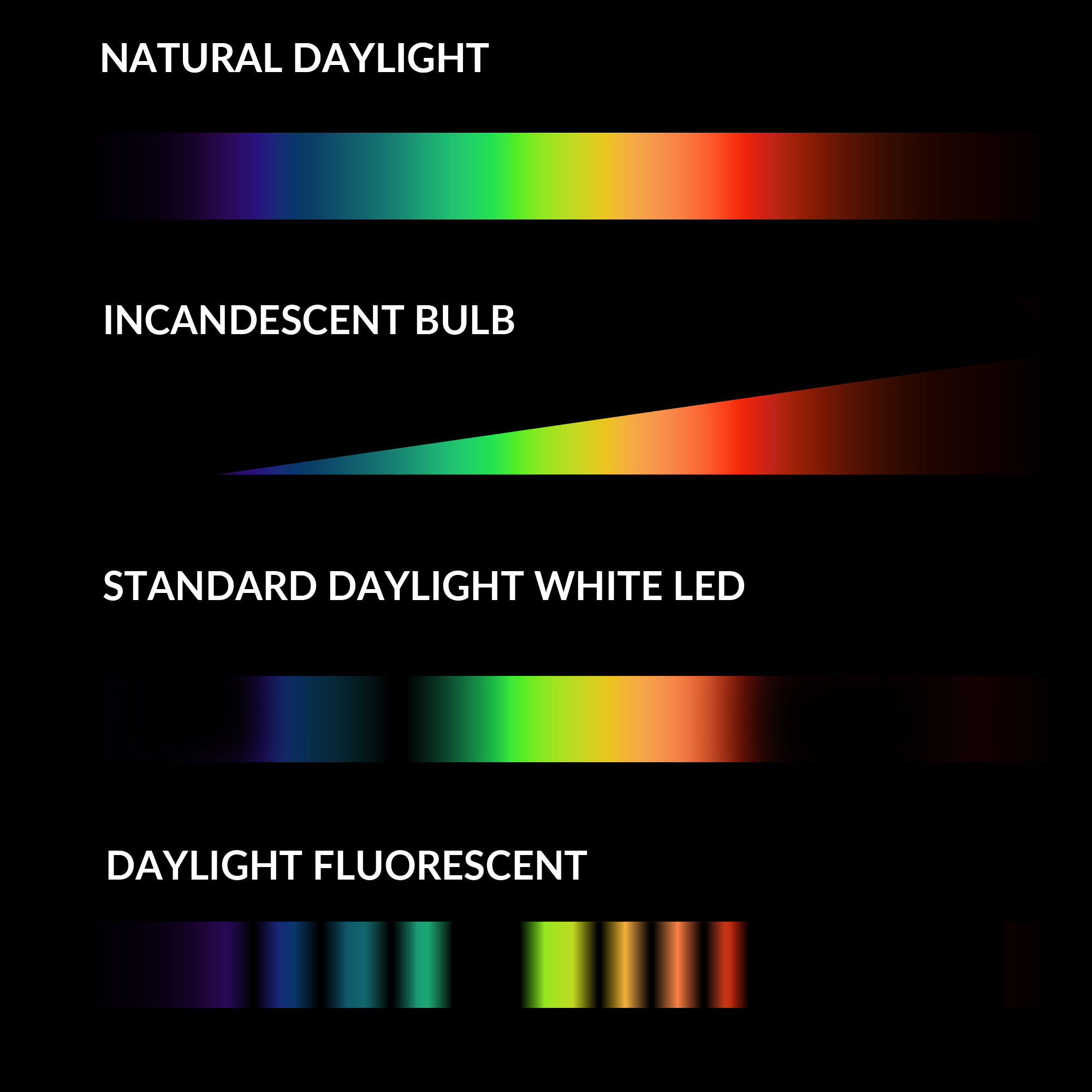
I healed my eczema with red light (infrared heater) It turn out that infrared is needed by all our cells to get rid of inflammation. We are in an epidemic of autoimmune diseases partially caused by the lack of infrared.
The spectrum of halogen lights is continuous and closer to what we would get outside. Tungsten bulbs are also continuous but more tilted toward infrared. I think we will have unintended consequence of everyone switching to led lights: the "wasted" infrared are actually useful for our body.
It is wise to assume that almost everything from the natural environment is connected to our biology. As we move further away from it we stack up the health problems self inflicted: crooked teeth, wisdom teeth, miopia, acnee, vid-d deficiency, autoimmune diseases, depression, anxiety, etc.
Search "Medcram infrared" it’s a doctor that explain the science behind it.